
Generative Radial Geometry in Astronomy: A New Paradigm for Radial Modeling
Category: Generative Radial Geometry (GRG)
Tags: astronomy, cosmology, radial models, gravitational lensing, data visualization
Abstract. Generative Radial Geometry (GRG) is a discrete, π-free approach that models shapes from the inside-out via radial generation. Because many cosmic phenomena are radially organized—from galactic halos to gravitational lenses—GRG offers natural, efficient tools to simulate, analyze, and visualize the universe.
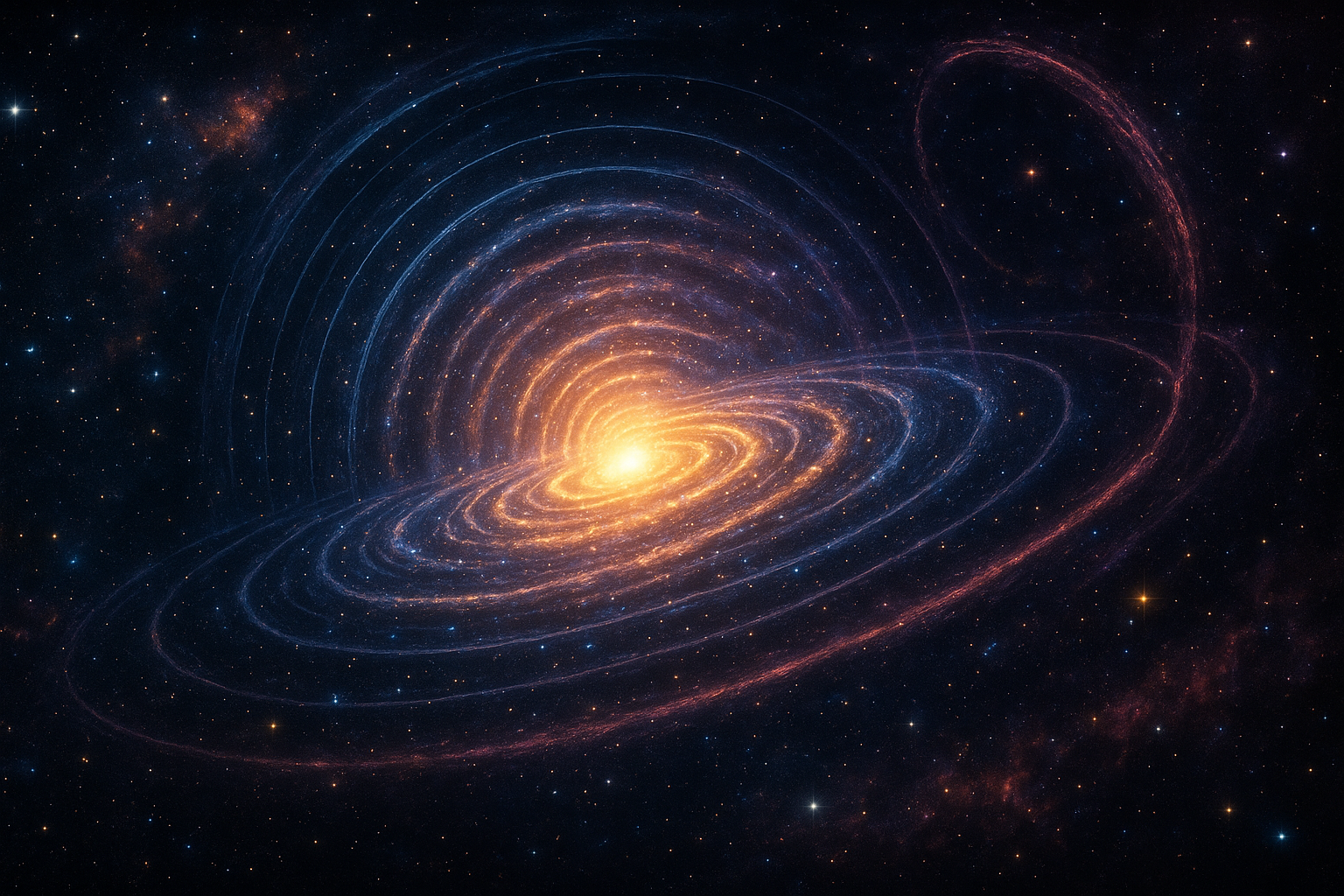
Hero — Radial Layers with Logarithmic Arms (turn-based)
Radial Mapping of Stellar and Galactic Systems
Galaxies and clusters frequently exhibit radial or pseudo-radial structure. GRG models such systems as cumulative radial layers:
This representation captures luminosity gradients and supports multi-scale “zoom” without discontinuities.
Dark Matter Distribution
Halo profiles are commonly modeled by radial functions such as the Navarro–Frenk–White (NFW) profile:
In GRG, synthetic halos arise from discrete radial accumulation, enabling efficient comparisons with survey data.
Gravitational Lensing Simulations
Deflection stems from radial potentials. Under GRG, a quick discretized approximation is:
where M(r) is the generative radial mass. The map below shows curved light-ray paths and equipotential-like curves around a central mass.
Spherical Surveys and Data Navigation
Large surveys (e.g., GAIA) live in spherical coordinates. GRG promotes seamless inside-out navigation using radial and angular indexing:
This allows continuous navigation across scales and directions without discontinuities.
Computational Benefits
- Multi-scale coherence: continuous zoom from core to periphery
- Simplified algorithms in radial/turn coordinates
- Natural fit for circular or spherical symmetries
- Efficient indexing and clustering (e.g., “find all stars within r = 5 pc”)
- Digital-native arithmetic: sums and square roots, π-free
Conclusion
Applying GRG to astronomy yields natural models of cosmic structure, high-fidelity simulations, and streamlined analysis pipelines. It couples geometric intuition with computational efficiency and offers a practical language for radial phenomena.