
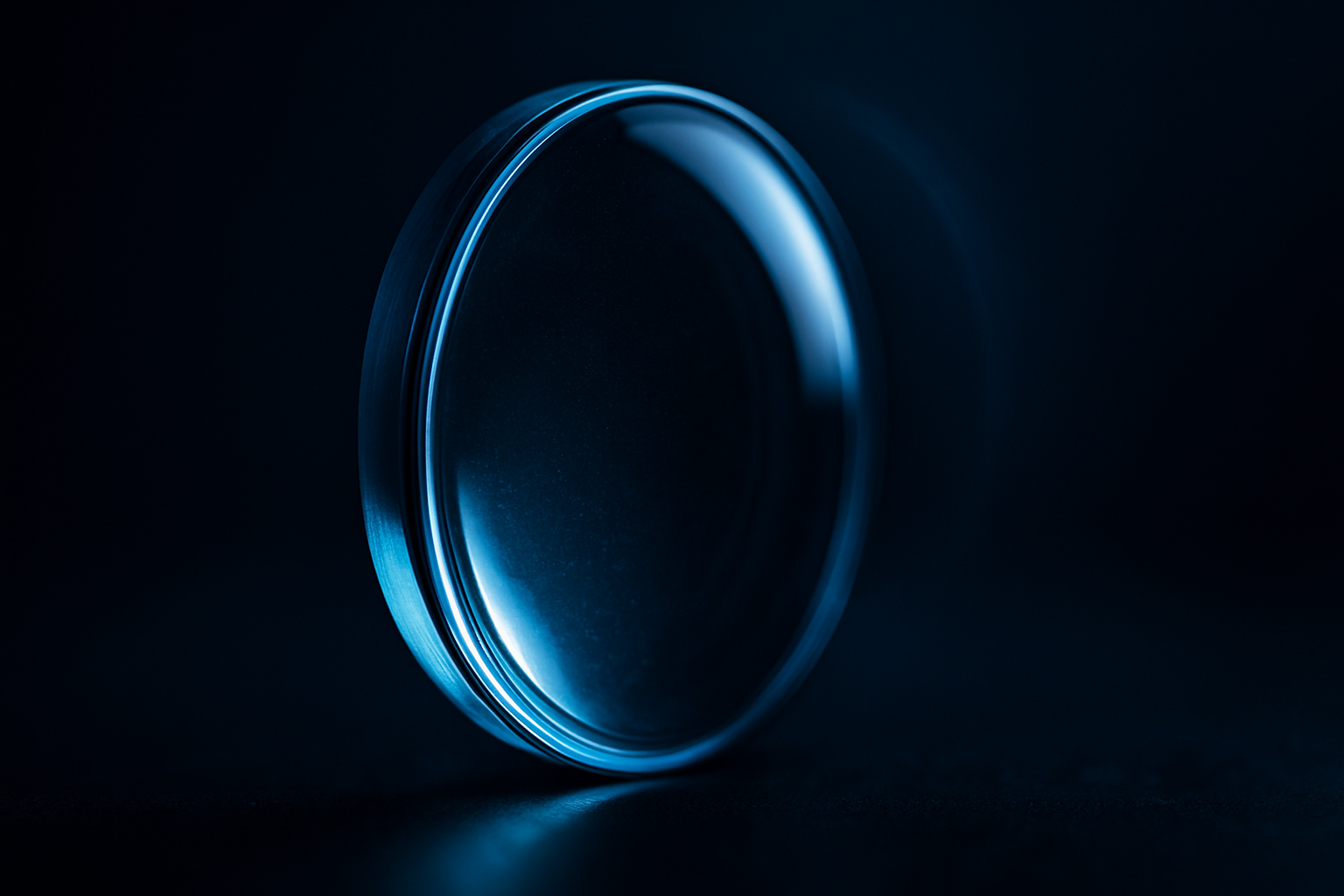
GRG Lens — Points • Dual Surface • ERG Volume • Smooth (C²)
We build the closed solid and compute the ERG volume, then apply Smooth$_\varepsilon$ with $C^{2}$ continuity to avoid optical edges.
1) Definitions (curvatures & adaptive step)
- Principal curvatures $(\kappa_1,\kappa_2)$; $\kappa_{\max}=\max(|\kappa_1|,|\kappa_2|)$.
- Local step $h(u,v)$: imposed by $2\sqrt{\varepsilon/\kappa_{\max}}$.
- Perfect at scale $\varepsilon$: geometric deviation $\le \varepsilon$ on the whole lens.
Axisymmetric case $z=f(r)$
2) Points → Dual surface → ERG volume
2.1 Points (adaptive radial–angular grid)
Sample $S_1$ and $S_2$ with $\Delta r$, $\Delta \theta$ such that local geodesic spacing never exceeds $h(u,v)$. Density increases where $\kappa_{\max}$ is higher (small radii or high-curvature regions).
2.2 Surfaces and closure
Build two coherent meshes $S_1, S_2$ and close with a thin lateral ring (cylindrical rim) to obtain a closed, oriented solid.
2.3 ERG volume
Tetrahedra method (as for the sphere) on the closed mesh:
If axisymmetric, cylindrical shells give a consistent Riemann sum:
which matches the tetrahedra estimate with $O(h^{2})$ error when the sampling bound is enforced.
3) Smooth$_{\varepsilon}$ for optics (C² continuity)
Goal: remove micro-faceting and guarantee surface and derivative continuity ($C^{2}$) for stable normals and curvature.
- Local MLS/RBF fit (degree $\ge 2$) on a radius $\rho\in[h,2h]$ for each face.
- Resample vertices on the smoothed patches; deviation $\le \varepsilon/2$.
- Normal filtering along geodesic neighborhoods, bandwidth $\propto \varepsilon$.
- Optical check: angular variation of normals consistent with expected faceting and no edges (no $C^{1}$ discontinuities).
- Topology check: no self-intersections after smoothing.
4) Algorithm (concise)
input: surfaces S1, S2 (or z1=f1(r), z2=f2(r)), ε
for each face S∈{S1, S2}:
    compute κ_max(u,v)  # or, for revolution, κ_mer(r), κ_circ(r)
    set h(u,v) ← 2*sqrt(ε/κ_max(u,v))
    generate adaptive grid (Δr, Δθ) satisfying h

T ← triangulate(S1) ∪ triangulate(S2) ∪ cylindrical_rim
orient(T)
A ← sum_areas(T)
V_ERG ← tetra_volume(T)

if optical requirements:
    T' ← smooth_MLS_RBF_C2(T) with deviation ≤ ε/2
    check_normals(T')          # continuity & angular variation
    check_self_intersections(T')
output: (closed mesh T', A, V_ERG, normals)
5) Checks & validation
- Hausdorff (ideal ↔ mesh) $\le \varepsilon$.
- $C^{2}$ continuity after smoothing (tests on numerical derivatives of patches).
- Triangle quality and no self-intersections.
- (Optional) qualitative optical test: no “steps”.
6) Why it matters
Lenses require $C^{2}$ continuity: even tiny edges degrade refraction. GRG adaptive sampling densifies where needed; Smooth$_\varepsilon$ controls deviation. The result is a lens “perfect at the chosen resolution”, with validated ERG volume.
7) Figures (inline SVG)
8) FAQ
How do I choose $\varepsilon$ for optics?
Start from the required form tolerance (e.g., $\lambda/10$ or microns) and translate it into a geometric deviation limit.
Does smoothing alter dioptric power?
No, if capped at $\varepsilon/2$ and validated with deviation maps and derivative checks.
What about the rim?
Close with a coherent ring: no sharp or inverted edges; enforce correct orientation.
ERG Quick Calculator
This compact tool computes the quarter-sampling step Δu and the grid size K from the dyadic level b, previews the uk values, and exports the grid to CSV.
Inputs
- Dyadic level b ∈ ℕ≥0 (recommended range: 0–18)
- Optional: recent estimates V2b-1 and V2b to check the dyadic stopping rule
Calculator
Results
- Δu =
—(exact:—) - K =
—(i.e., number of grid points) - N =
—(turns-first level, N = 2b)
Preview of u-grid uk = k · Δu
First 8: —
Last 8: —
Practical checklist
- Use dyadic refinement: increase b until the dyadic difference falls below ε.
- Quarter-sampling is assumed: Δu = 2-(b+2).
- Grid is deterministic; CSV can be versioned for reproducibility.