
Scientific correction — 13 October 2026
The application intervals and charts on this historical page are proposals or illustrations, not certified bounds for arbitrary fields or validated performance results. Certification requires assumptions on each integrand, a proved quadrature residual, rounding control, and propagation through subsequent transformations. Regular circular-sector bounds do not automatically bound optical, chemical, or anisotropic quantities.
Current reference: Circle and Area from Binary Radial Modules.
Generative Radial Geometry in Physics: Radial Models Across Scales
Category: Generative Radial Geometry (GRG)
Tags: physics, electromagnetism, quantum mechanics, condensed matter, wave propagation
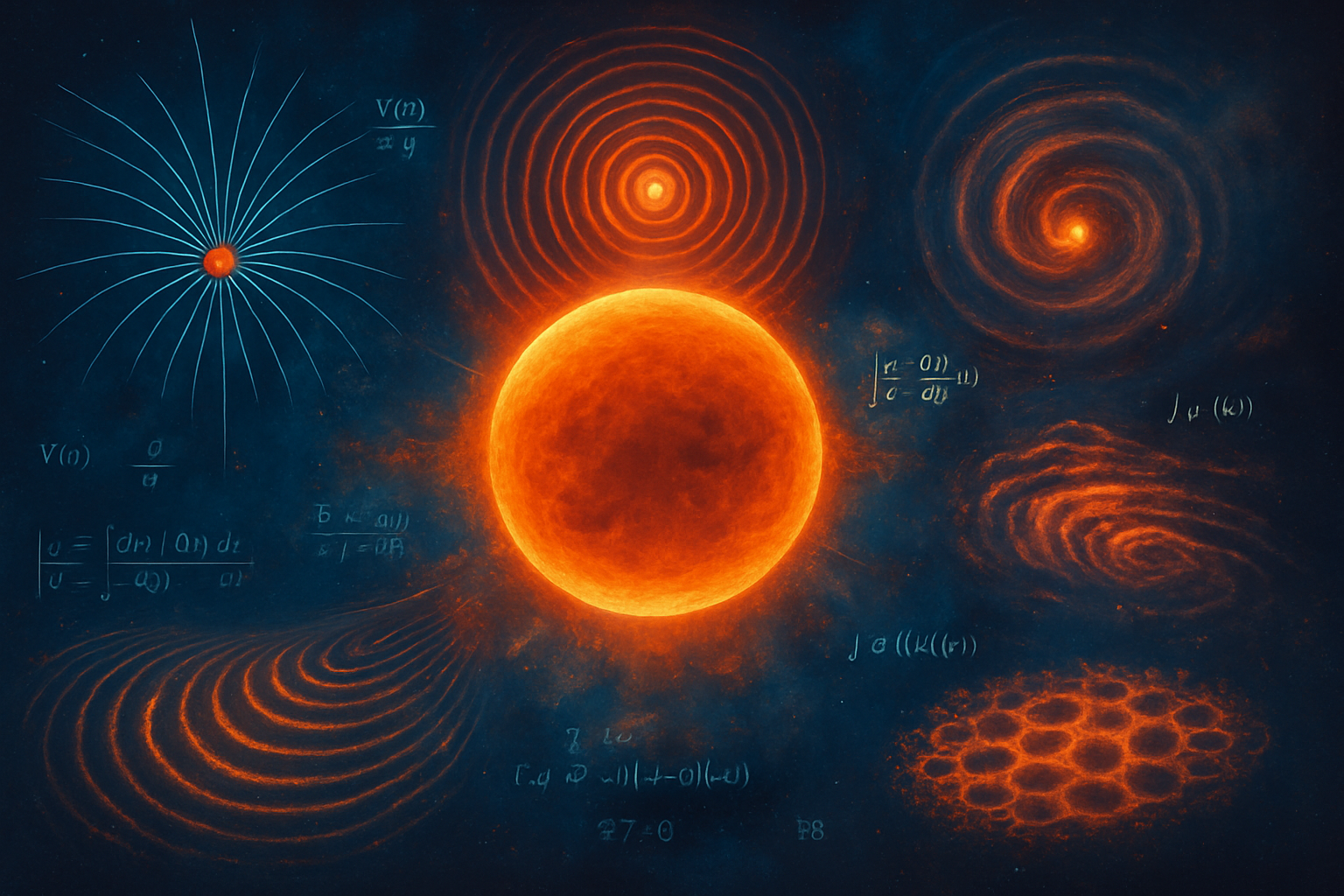
Abstract. Many physical phenomena are inherently radial: fields, waves, and potentials often depend primarily on the distance from a center. Generative Radial Geometry (GRG) provides a constructive, π-free approach to model, simulate, and visualize these systems through concentric layers and radial discretization. This article illustrates applications of GRG in major areas of physics.
GRG Modes & Quick Picker
Δx Trapezoidal (Cartesian)
- Target: area on a quarter (by symmetry); estimate: lower.
- Heights \(h_i=\sqrt{R^2-x_i^2}\) with \(\Delta x=R/N\). Fast baseline integration for energy/flux cross-sections.
Projection Corridor (Cartesian)
- Target: area on a quarter; estimate: lower & upper.
- Right-endpoint vs midpoint bars → proposed (not independently certified) bounds and convergence checks.
Chord-Sum at Δu (Radial)
- Target: circumference on the full turn; estimate: lower.
- Inscribed polygon with \(\Delta u=1/N\); pair with a circumscribed tangent-sum for upper bounds.
Method picker (by task): cross-section integrals → Trapezoid/Corridor; error-bounded areas → Corridor; loop/perimeter or phase → Chord-Sum (± tangent-sum); 3D shells/belts for volumetric fields and transport.
1. Fields and Electromagnetism
Example A – Electric field of a point charge:
With GRG, concentric radial layers represent flux around multiple charges, visualizing field lines at different scales.
Example B – Gravitational potential of a spherical mass:
GRG builds 3D maps of the potential and simulates test-particle trajectories in radial orbits.
GRG modes: Trapezoid for fast radial flux integrals; Corridor for bounds on energy over cross-sections; Chord-Sum for closed-loop circulation/perimeter (pair with tangent-sum for bounds).
2. Quantum Mechanics
Example A – Hydrogen atom states: The wavefunction separates into radial part \(R_{n\ell}(r)\) and angular part \(Y_{\ell m}(\theta,\varphi)\). GRG discretizes \(R_{n\ell}(r)\) on radial lattices, reconstructing 3D probability clouds.
Example B – Central harmonic oscillator:
GRG visualizes radial energy levels and wavefunctions.
GRG modes: Trapezoid/Corridor for radial probability/energy integrals (with bounds); Chord-Sum for phase on circular paths or ring traps; 3D shell sums for normalization/expectation over spheres.
3. Fluid Dynamics and Plasmas
Example A – Radial plasma outflow (solar wind): Velocity \(v(r)\) and density \(\rho(r)\) vary with distance from the Sun. GRG constructs radial flow maps and shock profiles.
Example B – Accretion disk stability: Radial perturbations \(\delta\Sigma(r)\) satisfy Sturm–Liouville equations. GRG produces concentric density/pressure maps to study instabilities.
GRG modes: Corridor to bracket mass/flux through circular sections; Trapezoid for fast updates in time-stepping; Chord-Sum to track expanding wavefront perimeters.
4. Condensed Matter Physics
Example A – Metallic nanoparticle: Electronic density of states \(g(r,E)\) varies radially. GRG simulates plasmon resonances (volume vs surface modes).
Example B – Heat diffusion in a sphere:
GRG discretizes concentric shells to generate radial temperature solutions.
GRG modes: 3D shell/frusta extensions for volumetric integrals; Corridor for error-controlled cross-sectional energy; Trapezoid for quick area-based approximations.
5. Acoustics and Elastic Waves
Example A – Radial sound waves:
GRG generates concentric pressure fields for wave propagation.
Example B – Resonances in spherical cavities: Solutions involve spherical Bessel functions \(j_\ell(kr)\). GRG maps radial nodes and mode structures.
GRG modes: Chord-Sum for wavefront loops and boundary phase; Corridor to bound average energy over sections; 3D shell sums for full energy content.
6. Nonlinear Dynamics and Pattern Formation
Example A – Radial reaction–diffusion:
GRG generates concentric patterns (e.g., chemical oscillations of Belousov–Zhabotinsky type).
Example B – Shock waves: Radial GRG models produce animated fronts and radial profiles of pressure and density.
GRG modes: Corridor for bounds in reactive mass/energy; Trapezoid for fast snapshots; Chord-Sum to track shock ring perimeters and speed.
Conclusion
Across physics, GRG offers a unified radial framework to generate, analyze, and visualize systems with spherical or circular symmetry. By choosing among Δx Trapezoidal, Projection Corridor, and Chord-Sum at Δu—or combining them—you can obtain fast baselines, proposed (not independently certified) bounds, and tight perimeter/phase control. In 3D, their shell/belt/frusta extensions scale the same logic to full volumetric phenomena.