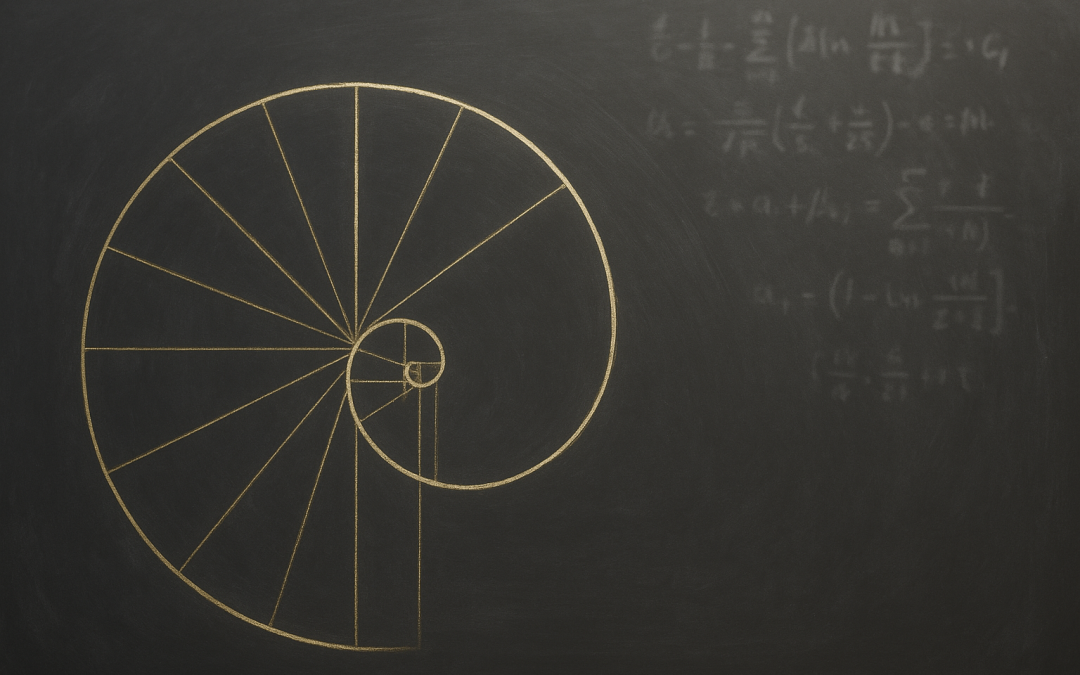
The binary radial formulation combines complementary internal and external sector triangles. The area kernel uses one internal contribution and two external contributions, unlike the circumference kernel’s two-to-one chord–tangent balance.
Geometric Elements
Resolve one Turn into N equal symmetric sectors. Let a be the internal triangle’s height, h half its chord, and e half the external tangent side. Define q = h/a.
$$ N=2^b,\quad b\ge2,\quad R>0,\qquad a^2+h^2=R^2,\quad e=R\frac ha. $$
Regular geometric bisection yields a scale bound. Together with the expansion, it proves second-order total error for the arithmetic kernel and fourth-order total error for the weighted kernel in exact arithmetic.
The earlier version introduced this quarter-step sampling parameter inside each module. The proof here concerns the complete sector triangles defined above. A different sample-based area construction requires its own explicit definition and proof.
Internal–external weights are reversed between the circumference and area kernels. This diagram is schematic; the triangle definitions determine the calculation.
Research Status
The cancellation is established for the regular triangular elements above. This does not establish original authorship of the weighting, numerical stability of an implementation, or a computational advantage. Those questions require separate literature and implementation comparisons.
Earlier revisions of this page described fourth-order behaviour as a candidate. The current analytical clarification identifies the geometric assumptions under which that behaviour follows.
A GRG Formulation: Circle and Area from a Binary Radial Framework
Generative Radial Geometry describes circular measures through a finite binary radial framework. Its working quantities are a radius, a full Turn, a binary resolution, and local chord–tangent constructions.
About the Current GRG Formulation
This page presents the documented binary radial formulation, with geometric definitions and an explicit verification of its measurement kernels. Earlier approaches, including Original Projection and previous Turns formulations, remain part of the research history.
The geometric construction, kernel accuracy, and computational efficiency are separate subjects. The analysis below establishes accuracy for regular symmetric sectors. It does not establish a performance advantage or prescribe an implementation.
The weighted area proposal is documented in A Symmetric GRG Kernel for Area. The geometric ratio notation and proofs below are an analytical clarification of the documented triangles and kernels.
Binary Turns and Resolution
A full rotation is one Turn. Resolve it into equal sectors. The nondegenerate chord–tangent formulas on this page require at least four sectors.
Let a be the distance from the centre to the internal chord, h half that chord, and e half the external tangent side. The tangent is perpendicular to the central radius. The two boundary rays intersect both the circle and this tangent.
$$ a^2+h^2=R^2,\qquad e=R\frac ha. $$
Figure 1 — Symmetric sector: internal chord, central radius, and external tangent side.
Define dimensionless ratios from these constructed lengths:
$$ c_b=\frac aR,\qquad s_b=\frac hR,\qquad q_b=\frac ha. $$
The weighting is a known local arc approximation. This formulation uses it as a kernel within the binary radial framework; the weighting itself is not claimed as an original GRG result.
Area Elements and Kernels
The internal triangle has base 2h and height a. The external triangle has base 2e and height R.
The following identity is used to verify regular equal-sector bisection. It is a geometric consequence, not an attribution of a particular numerical algorithm to GRG.
At four sectors the half-sector triangle has equal legs, so q₂ = 1. Bisecting its direction gives the following ratio, obtained by normalising the boundary direction and adding it to the central unit direction:
$$ q_{b+1}=\frac{q_b}{1+\sqrt{1+q_b^2}}. $$
The denominator is at least two. Induction therefore gives:
$$ 0\lt q_b\le 2^{2-b}=\frac4N. $$
This proves the scale bound needed for the global error estimates. It uses the regular bisection geometry; it does not require a precomputed full-Turn length or area.
Kernel Accuracy: Analytical Verification
Define the local integral below solely as an analytical reference for the exact sector measures. It is not an input to the measurement kernels.
$$ F(q)=\int_0^q\frac{dt}{1+t^2}. $$
Parameterising the circular boundary by its slope gives exact sector arc length 2RF(q) and exact sector area R²F(q). Thus the fixed full-Turn reference measures satisfy:
$$ C_T(R)=2NRF(q_b),\qquad A_T(R)=NR^2F(q_b). $$
$$ F(q)=q-\frac{q^3}{3}+\frac{q^5}{5}+O(q^7). $$
Substitution into the circumference kernels yields:
The area weighting cancels the cubic local residual. Combining these expansions with the geometric scale bound proves, for fixed radius and exact arithmetic:
Both derivatives are nonnegative for 0 ≤ q ≤ 1, which covers the sectors considered here. Consequently the bracket follows for every b ≥ 2, rather than only for tested resolutions.
The related area article specifies quarter-step sampling within a module. The verification above concerns the complete sector triangles. An implementation using internal samples must specify how those samples evaluate the same elements; the sampling parameter alone does not define an additional area kernel.
Figure 2 — Binary sector refinement at N = 4, 8, and 16.
Computational Efficiency and Research Scope
Binary resolution is compatible with binary angular indices and power-of-two scaling. A performance advantage for the complete calculation must nevertheless be measured.
A reproducible comparison must use equal accuracy targets, include generation or retrieval of the local measures, account for precomputation and memory, and specify arithmetic precision, rounding, hardware, and execution time. Stability in fixed-point arithmetic requires a separate error analysis.
The results established here concern the documented regular chord–tangent geometry and its kernels. Historical originality and implementation efficiency are separate investigations.
Sample $S_1$ and $S_2$ with $\Delta r$, $\Delta \theta$ such that local geodesic spacing never exceeds $h(u,v)$.
Density increases where $\kappa_{\max}$ is higher (small radii or high-curvature regions).
2.2 Surfaces and closure
Build two coherent meshes $S_1, S_2$ and close with a thin lateral ring (cylindrical rim) to obtain a closed, oriented solid.
2.3 ERG volume
Tetrahedra method (as for the sphere) on the closed mesh:
which matches the tetrahedra estimate with $O(h^{2})$ error when the sampling bound is enforced.
3) Smooth$_{\varepsilon}$ for optics (C² continuity)
Goal: remove micro-faceting and guarantee surface and derivative continuity ($C^{2}$) for stable normals and curvature.
Local MLS/RBF fit (degree $\ge 2$) on a radius $\rho\in[h,2h]$ for each face.
Resample vertices on the smoothed patches; deviation $\le \varepsilon/2$.
Normal filtering along geodesic neighborhoods, bandwidth $\propto \varepsilon$.
Optical check: angular variation of normals consistent with expected faceting and no edges (no $C^{1}$ discontinuities).
Topology check: no self-intersections after smoothing.
4) Algorithm (concise)
input: surfaces S1, S2 (or z1=f1(r), z2=f2(r)), ε
for each face S∈{S1, S2}:
    compute κ_max(u,v)  # or, for revolution, κ_mer(r), κ_circ(r)
    set h(u,v) ← 2*sqrt(ε/κ_max(u,v))
    generate adaptive grid (Δr, Δθ) satisfying h

T ← triangulate(S1) ∪ triangulate(S2) ∪ cylindrical_rim
orient(T)
A ← sum_areas(T)
V_ERG ← tetra_volume(T)

if optical requirements:
    T' ← smooth_MLS_RBF_C2(T) with deviation ≤ ε/2
    check_normals(T')          # continuity & angular variation
    check_self_intersections(T')
output: (closed mesh T', A, V_ERG, normals)
5) Checks & validation
Hausdorff (ideal ↔ mesh) $\le \varepsilon$.
$C^{2}$ continuity after smoothing (tests on numerical derivatives of patches).
Triangle quality and no self-intersections.
(Optional) qualitative optical test: no “steps”.
6) Why it matters
Lenses require $C^{2}$ continuity: even tiny edges degrade refraction. GRG adaptive sampling densifies where needed; Smooth$_\varepsilon$ controls deviation. The result is a lens “perfect at the chosen resolution”, with validated ERG volume.
7) Figures (inline SVG)
L2 — Meridional section (profiles $z_1$, $z_2$) and rim closure.L1 — Density map driven by $\kappa_{\max}$: smaller $h$ where curvature is higher.
8) FAQ
How do I choose $\varepsilon$ for optics?
Start from the required form tolerance (e.g., $\lambda/10$ or microns) and translate it into a geometric deviation limit.
Does smoothing alter dioptric power?
No, if capped at $\varepsilon/2$ and validated with deviation maps and derivative checks.
What about the rim?
Close with a coherent ring: no sharp or inverted edges; enforce correct orientation.
ERG Quick Calculator
This compact tool computes the quarter-sampling step Δu and the grid size K from the dyadic level b, previews the uk values, and exports the grid to CSV.
Inputs
Dyadic levelb ∈ ℕ≥0 (recommended range: 0–18)
Optional: recent estimates V2b-1 and V2b to check the dyadic stopping rule
\[ \Delta u \;=\; 2^{-(b+2)}, \qquad
K \;=\; \left\lfloor \frac{1}{\Delta u} \right\rfloor \;=\; 2^{\,b+2}. \]
The sphere is an ideal testbed: constant curvature and closed-form $A,V$.
The chain points → surface → ERG volume → smooth at scale $\varepsilon$ sets the general GRG/ERG procedure for solids.
7) Figures (inline SVG)
F3 — Sagitta relation used to bound $h_{\max}$.F1 — Point distribution (Fibonacci vs icosphere idea) at equal $h$.
8) FAQ
Is “perfect” absolute? No: it is perfect at scale $\varepsilon$. Details $<\,\varepsilon$ are not guaranteed.
Do we always need smoothing? No: needed for normals/optics stability; otherwise optional.
Fibonacci or icosphere? Both work: Fibonacci is simple and isotropic; icosphere offers regular connectivity.
How do I choose $\varepsilon$? Based on use: measurement accuracy, rendering, fabrication, etc.
ERG Quick Calculator
This compact tool computes the quarter-sampling step Δu and the grid size K from the dyadic level b, previews the uk values, and exports the grid to CSV.
Inputs
Dyadic levelb ∈ ℕ≥0 (recommended range: 0–18)
Optional: recent estimates V2b-1 and V2b to check the dyadic stopping rule
\[ \Delta u \;=\; 2^{-(b+2)}, \qquad
K \;=\; \left\lfloor \frac{1}{\Delta u} \right\rfloor \;=\; 2^{\,b+2}. \]
Complexity must identify the task, algorithm, arithmetic precision, and output representation. This page distinguishes costs rather than assigning a single complexity to all GRG methods.
Scalar Kernel Evaluation
Given local geometric ratios, the current circle kernels require a fixed number of arithmetic operations. Obtaining the ratios has its own cost. A binary-bisection evaluation performs a number of refinement stages proportional to the binary depth; square-root cost depends on precision and implementation.
Explicit Geometry
Generating and storing all sector nodes has a cost proportional to the output count. Streaming may reduce storage, but does not remove output work.
Raster and Volume Tasks
Boundary drawing, disk filling, surface generation, and voxel filling have different output sizes. Their cost statements must specify whether every output element is generated.
Comparisons
Report setup, precomputation, precision, memory, and runtime at equal achieved accuracy under the benchmark protocol. Earlier repeated cost models have been consolidated here.
The current formulation defines regular equal sectors, local chord–tangent lengths, triangular areas, and weighted kernels. Its proofs concern those definitions.
A runnable method must identify initial values, refinement or direct evaluation, arithmetic format, outputs, and stopping conditions. A geometry identity alone is not a runtime benchmark.
Extensions
Adaptive sampling, general curves, multiple seeds, and three-dimensional constructions require their own definitions and validation. No error order or performance advantage is transferred automatically from the regular-circle proof.
To provide the best experiences, we use technologies like cookies to store and/or access device information. Consenting to these technologies will allow us to process data such as browsing behavior or unique IDs on this site. Not consenting or withdrawing consent, may adversely affect certain features and functions.
Functional
Always active
The technical storage or access is strictly necessary for the legitimate purpose of enabling the use of a specific service explicitly requested by the subscriber or user, or for the sole purpose of carrying out the transmission of a communication over an electronic communications network.
Preferences
The technical storage or access is necessary for the legitimate purpose of storing preferences that are not requested by the subscriber or user.
Statistics
The technical storage or access that is used exclusively for statistical purposes.The technical storage or access that is used exclusively for anonymous statistical purposes. Without a subpoena, voluntary compliance on the part of your Internet Service Provider, or additional records from a third party, information stored or retrieved for this purpose alone cannot usually be used to identify you.
Marketing
The technical storage or access is required to create user profiles to send advertising, or to track the user on a website or across several websites for similar marketing purposes.