

A Symmetric GRG Kernel for Area

A Symmetric GRG Kernel for Area

A Symmetric GRG Kernel for Area

The binary radial formulation combines complementary internal and external sector triangles. The area kernel uses one internal contribution and two external contributions, unlike the circumference kernel’s two-to-one chord–tangent balance.

Geometric Elements

Resolve one Turn into N equal symmetric sectors. Let a be the internal triangle’s height, h half its chord, and e half the external tangent side. Define q = h/a.

$$
N=2^b,\quad b\ge2,\quad R>0,\qquad a^2+h^2=R^2,\quad e=R\frac ha.
$$
$$
I_b=ah=R^2\frac{q_b}{1+q_b^2},\qquad E_b=Re=R^2q_b.
$$

Two Area Kernels

$$
A_m=\frac N2(I_b+E_b),\qquad A_w=\frac N3(I_b+2E_b).
$$

Accuracy for the Defined Triangles

The current formulation gives an analytical verification using a local integral as an exact sector reference, not as a kernel input.

$$
F(q)=\int_0^q\frac{dt}{1+t^2},\qquad A_T(R)=NR^2F(q_b).
$$
$$
\begin{aligned}A_m-A_T&=NR^2\left(-\frac{q_b^3}{6}+\frac{3q_b^5}{10}+O(q_b^7)\right),\\A_w-A_T&=NR^2\left(\frac{2q_b^5}{15}+O(q_b^7)\right).\end{aligned}
$$

Regular geometric bisection yields a scale bound. Together with the expansion, it proves second-order total error for the arithmetic kernel and fourth-order total error for the weighted kernel in exact arithmetic.

$$
0\lt q_b\le\frac4N,\qquad A_m-A_T=O(N^{-2}),\qquad A_w-A_T=O(N^{-4}).
$$

The same analysis proves the following bracket for these sectors:

$$
A_{\mathrm{in}}\le A_m\le A_T\le A_w\le A_{\mathrm{out}}.
$$

Sampling and Scope

$$
\Delta u=\frac1{4N}.
$$

The earlier version introduced this quarter-step sampling parameter inside each module. The proof here concerns the complete sector triangles defined above. A different sample-based area construction requires its own explicit definition and proof.

GRG length and area kernel inversion A clean schematic comparison between the GRG circumference kernel, based on two internal chord contributions and one external tangent contribution, and the proposed GRG area kernel, based on one internal area contribution and two external area contributions. Length kernel 2 chord + 1 tangent Chord Chord Tangent Area kernel 1 internal + 2 external Internal External External weight inversion
Internal–external weights are reversed between the circumference and area kernels. This diagram is schematic; the triangle definitions determine the calculation.

Research Status

The cancellation is established for the regular triangular elements above. This does not establish original authorship of the weighting, numerical stability of an implementation, or a computational advantage. Those questions require separate literature and implementation comparisons.

Earlier revisions of this page described fourth-order behaviour as a candidate. The current analytical clarification identifies the geometric assumptions under which that behaviour follows.
Turns & Precision

Turns & Precision

Turns & Precision

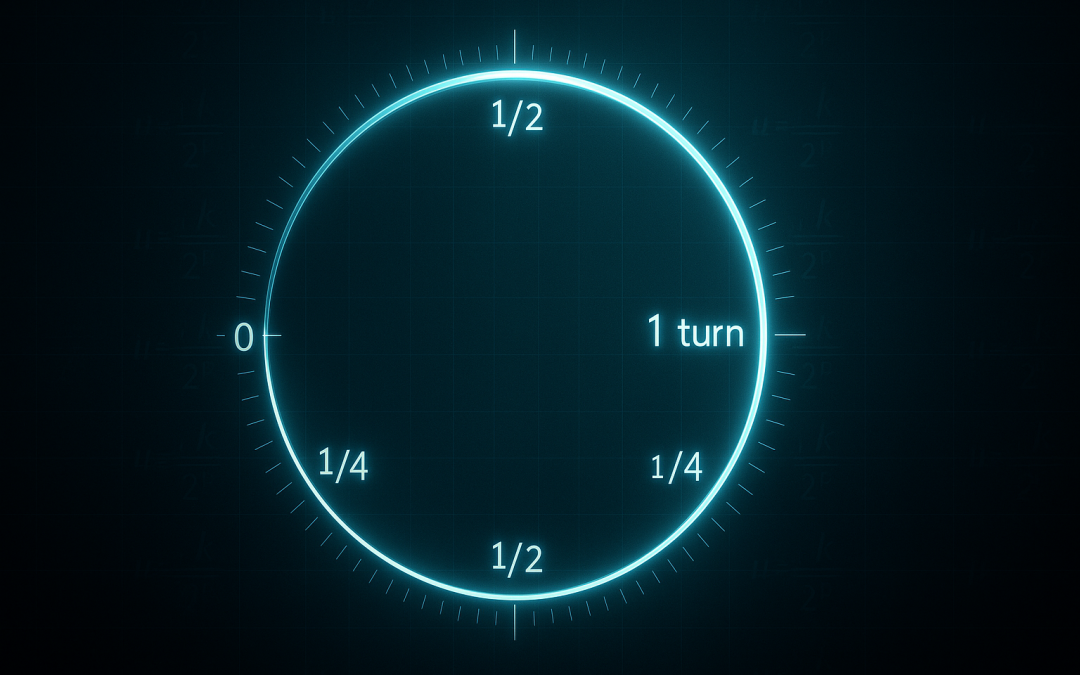
This page formalises the angle unit used across ERG/GRG. Angles are measured in turns (fractions of a full rotation). We also define a binary fixed-point representation for hardware/software precision.

Angle unit (turns)

A full rotation is \(1\) turn. Quarter-turn \(= \tfrac{1}{4}\), half-turn \(= \tfrac{1}{2}\), etc. Trigonometric functions are period-1 in turns: \(c(u),\, s(u)\) with \(c(0)=1,\ s(0)=0,\ c(\tfrac{1}{4})=0,\ s(\tfrac{1}{4})=1\).

Equal-angle partition (N sectors)

Choose the number of sectors \(N\) and set the step \(\Delta u = \tfrac{1}{N}\). Sampling angles: \(u_k = \tfrac{k}{N}\), \(k=0,\dots,N-1\).

Binary fixed-point turns (B bits)

Store angles as \(u = \tfrac{k}{2^{B}}\) turns with \(k \in \{0,\dots,2^{B}\!-\!1\}\). The angular resolution is \(\Delta u_B = 2^{-B}\). To get exactly \(N\) equal sectors, pick \(N\) dividing \(2^{B}\) (e.g. \(N=2^{B}\)). Then use indices \(k = m\,j\) with \(m = \tfrac{2^{B}}{N}\), \(j=0,\dots,N-1\).

0 1/8 1/4 3/8 1/2 5/8 3/4 7/8
Example with \(B = 3\) bits ⇒ \(2^{3}=8\) ticks. Increasing \(B\) doubles the ticks and the precision.

Why more bits ⇒ more accuracy

  • Circumference (chords): \( C_N \;=\; 2\,N\,r\, s\!\bigl(\tfrac{1}{2N}\bigr) \) is the inscribed \(N\)-gon perimeter; as \(N\) doubles, the step halves and the error typically drops ≈ \(\times 4\).
  • Area (sectors): \( A_N \;=\; \tfrac{N}{2}\,r^{2}\, s\!\bigl(\tfrac{1}{N}\bigr) \) behaves similarly (step-squared).

Quick reference

Inline: \( \Delta u = \tfrac{1}{N},\quad u_k = \tfrac{k}{N},\quad u = \tfrac{k}{2^{B}},\quad \Delta u_{B} = 2^{-B} \).
Display:

$$ C_{N} \;=\; 2\,N\,r\, s\!\Bigl(\frac{1}{2N}\Bigr), \qquad A_{N} \;=\; \frac{N}{2}\,r^{2}\, s\!\Bigl(\frac{1}{N}\Bigr). $$

Implementation notes

  • Keep an angle register \(k\) modulo \(2^{B}\) (wrap-around on \(B\) bits).
  • For LUTs of size \(2^{M}\) with \(M \le B\), index by \(k \gg (B-M)\).
  • Step-doubling check: compare \(N\) vs \(2N\) to gauge the remaining gap.