
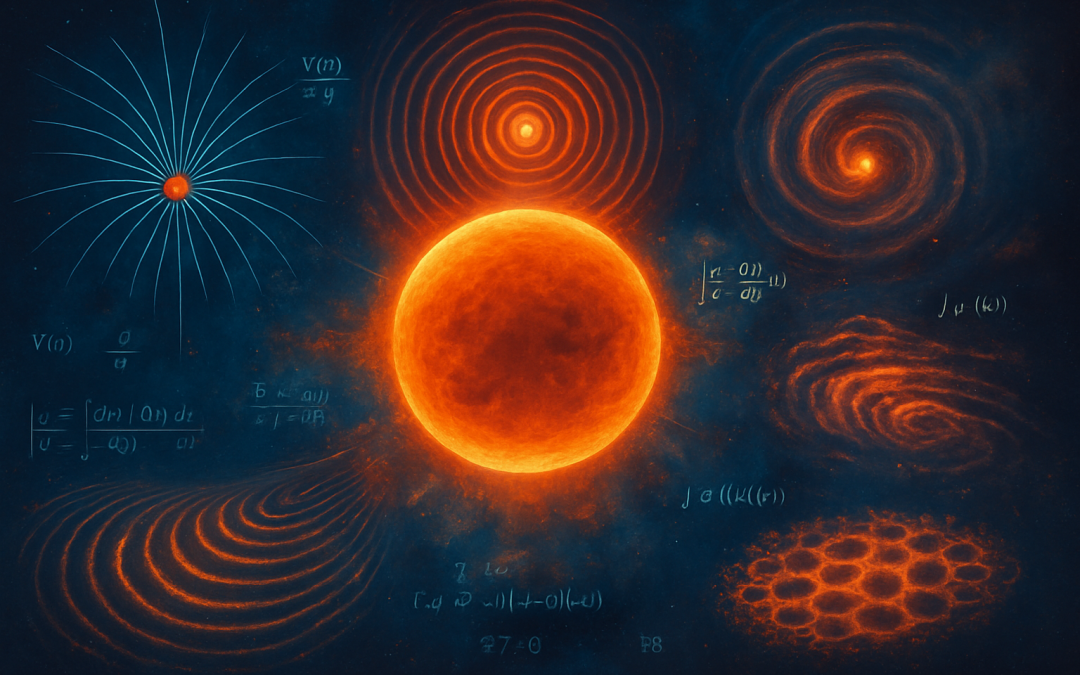
Physics
Generative Radial Geometry in Physics: Radial Models Across Scales
Category: Generative Radial Geometry (GRG)
Tags: physics, electromagnetism, quantum mechanics, condensed matter, wave propagation
Abstract. Many physical phenomena are inherently radial: fields, waves, and potentials often depend primarily on the distance from a center. Generative Radial Geometry (GRG) provides a constructive, π-free approach to model, simulate, and visualize these systems through concentric layers and radial discretization. This article illustrates applications of GRG in major areas of physics.
GRG Modes & Quick Picker
Δx Trapezoidal (Cartesian)
- Target: area on a quarter (by symmetry); estimate: lower.
- Heights \(h_i=\sqrt{R^2-x_i^2}\) with \(\Delta x=R/N\). Fast baseline integration for energy/flux cross-sections.
Projection Corridor (Cartesian)
- Target: area on a quarter; estimate: lower & upper.
- Right-endpoint vs midpoint bars → certified bounds and convergence checks.
Chord-Sum at Δu (Radial)
- Target: circumference on the full turn; estimate: lower.
- Inscribed polygon with \(\Delta u=1/N\); pair with a circumscribed tangent-sum for upper bounds.
Method picker (by task): cross-section integrals → Trapezoid/Corridor; error-bounded areas → Corridor; loop/perimeter or phase → Chord-Sum (± tangent-sum); 3D shells/belts for volumetric fields and transport.
1. Fields and Electromagnetism
Example A – Electric field of a point charge:
With GRG, concentric radial layers represent flux around multiple charges, visualizing field lines at different scales.
Example B – Gravitational potential of a spherical mass:
GRG builds 3D maps of the potential and simulates test-particle trajectories in radial orbits.
GRG modes: Trapezoid for fast radial flux integrals; Corridor for bounds on energy over cross-sections; Chord-Sum for closed-loop circulation/perimeter (pair with tangent-sum for bounds).
2. Quantum Mechanics
Example A – Hydrogen atom states: The wavefunction separates into radial part \(R_{n\ell}(r)\) and angular part \(Y_{\ell m}(\theta,\varphi)\). GRG discretizes \(R_{n\ell}(r)\) on radial lattices, reconstructing 3D probability clouds.
Example B – Central harmonic oscillator:
GRG visualizes radial energy levels and wavefunctions.
GRG modes: Trapezoid/Corridor for radial probability/energy integrals (with bounds); Chord-Sum for phase on circular paths or ring traps; 3D shell sums for normalization/expectation over spheres.
3. Fluid Dynamics and Plasmas
Example A – Radial plasma outflow (solar wind): Velocity \(v(r)\) and density \(\rho(r)\) vary with distance from the Sun. GRG constructs radial flow maps and shock profiles.
Example B – Accretion disk stability: Radial perturbations \(\delta\Sigma(r)\) satisfy Sturm–Liouville equations. GRG produces concentric density/pressure maps to study instabilities.
GRG modes: Corridor to bracket mass/flux through circular sections; Trapezoid for fast updates in time-stepping; Chord-Sum to track expanding wavefront perimeters.
4. Condensed Matter Physics
Example A – Metallic nanoparticle: Electronic density of states \(g(r,E)\) varies radially. GRG simulates plasmon resonances (volume vs surface modes).
Example B – Heat diffusion in a sphere:
GRG discretizes concentric shells to generate radial temperature solutions.
GRG modes: 3D shell/frusta extensions for volumetric integrals; Corridor for error-controlled cross-sectional energy; Trapezoid for quick area-based approximations.
5. Acoustics and Elastic Waves
Example A – Radial sound waves:
GRG generates concentric pressure fields for wave propagation.
Example B – Resonances in spherical cavities: Solutions involve spherical Bessel functions \(j_\ell(kr)\). GRG maps radial nodes and mode structures.
GRG modes: Chord-Sum for wavefront loops and boundary phase; Corridor to bound average energy over sections; 3D shell sums for full energy content.
6. Nonlinear Dynamics and Pattern Formation
Example A – Radial reaction–diffusion:
GRG generates concentric patterns (e.g., chemical oscillations of Belousov–Zhabotinsky type).
Example B – Shock waves: Radial GRG models produce animated fronts and radial profiles of pressure and density.
GRG modes: Corridor for bounds in reactive mass/energy; Trapezoid for fast snapshots; Chord-Sum to track shock ring perimeters and speed.
Conclusion
Across physics, GRG offers a unified radial framework to generate, analyze, and visualize systems with spherical or circular symmetry. By choosing among Δx Trapezoidal, Projection Corridor, and Chord-Sum at Δu—or combining them—you can obtain fast baselines, certified bounds, and tight perimeter/phase control. In 3D, their shell/belt/frusta extensions scale the same logic to full volumetric phenomena.