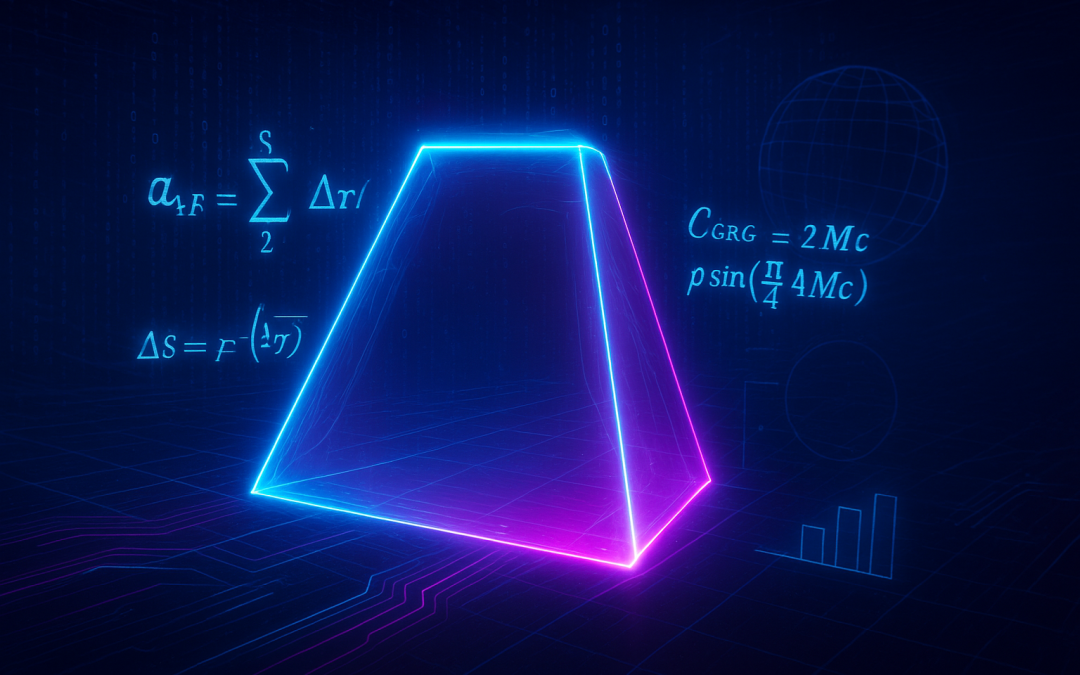
Describe the construction through its geometric definitions. Use plain language, explicit hypotheses, and reproducible evidence.
Current Formulas
Use geometric lengths and ratios. Keep circular constants outside the construction’s formulas and numerical kernel. Explicit computational comparisons may use reference constants, with their role clearly stated.
Claims and Evidence
Distinguish definitions, proved statements, numerical observations, proposals, and applications. Do not claim efficiency, numerical stability, exact hardware arithmetic, or originality without supporting evidence.
Versioning
Identify historical formulations and retain their provenance. The binary radial formulation is the current two-dimensional reference.
Presentation
Keep site content in English. Provide accessible diagram descriptions, readable mathematical displays, and verified links. Avoid polemical slogans and comparisons that imply an unmeasured advantage.
Explore Generative Radial Geometry (GRG): figures are generated from the center at a chosen resolution, without assuming π a priori.
Angles are measured in turns \(u\in[0,1)\) with period-1 trig \(c(u)=\cos(2\pi u),\ s(u)=\sin(2\pi u)\).
Controls
N = 24
Circumference is always from equal-angle chords in turns.
Sphere uses octant symmetry (×8) and π-free operators; volume is O(N²).
%
“Internal dominance” compares N to 2N (self-consistency). “Victory” compares to the π-based value (external).
Circle (2D)
Area estimate
—
Area corridor (if applicable)
—
Circumference (chords)
—
Internal Δ (N → 2N), area
—
Internal Δ (N → 2N), circumf.
—
External error vs π-based, area
—
External error vs π-based, circumf.
—
area: —circ: —
Sphere (3D)
Surface (octant fusion ×8)
—
Volume (stacked quarters ×8)
—
Internal Δ (N → 2N), surface
—
Internal Δ (N → 2N), volume
—
External error vs 4πr²
—
External error vs (4/3)πr³
—
surface: —volume: —
How the GRG Mini-App works — Circle & Sphere
What you control
Inputs. Two modules:
Circle (2D): choose radius r, subdivisions N and the Area method:
Note: for Δx/Original the slider N refers to the quarter; for Radial it refers to the full turn. Circumference always uses turns with equal-angle chords.
Sphere (3D): choose radius R, vertical slices Nz, radial trapezoids for quarter-areas Mr, and quarter-circumference subdivisions Mc.
Show traditional comparison toggles all external (vs π) quantities and the grey series in charts.
Show π estimates reveals π computed internally (from A/C in 2D; S/V in 3D).
Download CSV exports the full range (1…Nmax); Copy link preserves the current settings.
Status badges & thresholds
🟢 Internal dominance
The internal change between the current resolution and the doubled one is small relative to the value:
Area (Δx Trapezoidal): quarter sum of trapezoids with uniform \(\Delta x=r/N\) → ×4 (Kahan summation for stability).
Area (Original Projection): midpoint (upper) / right (lower) corridor on the quarter → ×4 (Kahan).
Area (Radial Sectors, turns): \(A_N=\tfrac{N}{2}r^2\,s(\tfrac{1}{N})\) with \(s(u)=\sin(2\pi u)\).
Circumference (turns): equal-angle chords on the full turn:
\(C_{N_{\text{full}}}=2N_{\text{full}}\,r\,s(\tfrac{1}{2N_{\text{full}}})\).
For Δx/Original we use \(N_{\text{full}}=4N\); for Radial, \(N_{\text{full}}=N\).
Formulas used — Sphere (3D)
Surface: octant fusion of quarter-circumferences along meridian (\(\Delta s\)), then ×8.
Volume: octant stacking of quarter-areas along \(z\) with trapezoid in \(\Delta z\), then ×8.
What this app demonstrates
GRG reconstructs circle and sphere without assuming π. With angles in turns and quarter/octant symmetries,
internal stabilization (dominance) precedes external agreement (victory).
Construct first, constants emerge.
GRG Mini-App — 3 righe
GRG Mini-App — 3 righe
Layout a righe: Controls → Circle (2D) → Sphere (3D). Tutti gli slider sono two-way con i numeri; i turns (U) hanno preview live (corde uguali).
Controls
Circle
Angular (turns)
Δu = 1/48 · Δθ = 0.130899694 rad
U multiple of 4 ✓; U = 4·N·k ✓
Sphere
Slider (mirrors)
Circle (2D)
Area (GRG)
0
Corridor width (mid−right)
—
Circumference (chords)
0
Δint A (2N vs N)
—
Δint C (2U vs U)
—
Δext A vs πr²
—
Δext C vs 2πr
—
area: —circ: —
Anteprima: poligono inscritto con U settori uguali (corde uguali).
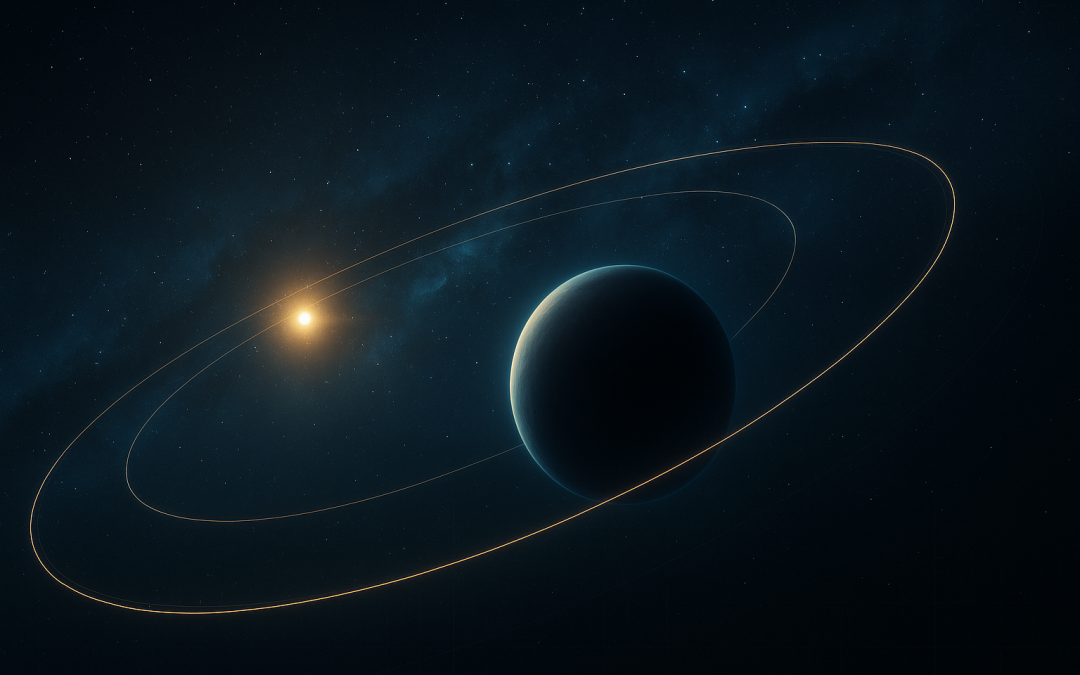
Equal-area stepping from the focus: constant \(\Delta A\) gives uniform time steps (Kepler’s 2nd law). Near periapsis the angular gaps shrink; away they widen.
To provide the best experiences, we use technologies like cookies to store and/or access device information. Consenting to these technologies will allow us to process data such as browsing behavior or unique IDs on this site. Not consenting or withdrawing consent, may adversely affect certain features and functions.
Functional
Always active
The technical storage or access is strictly necessary for the legitimate purpose of enabling the use of a specific service explicitly requested by the subscriber or user, or for the sole purpose of carrying out the transmission of a communication over an electronic communications network.
Preferences
The technical storage or access is necessary for the legitimate purpose of storing preferences that are not requested by the subscriber or user.
Statistics
The technical storage or access that is used exclusively for statistical purposes.The technical storage or access that is used exclusively for anonymous statistical purposes. Without a subpoena, voluntary compliance on the part of your Internet Service Provider, or additional records from a third party, information stored or retrieved for this purpose alone cannot usually be used to identify you.
Marketing
The technical storage or access is required to create user profiles to send advertising, or to track the user on a website or across several websites for similar marketing purposes.