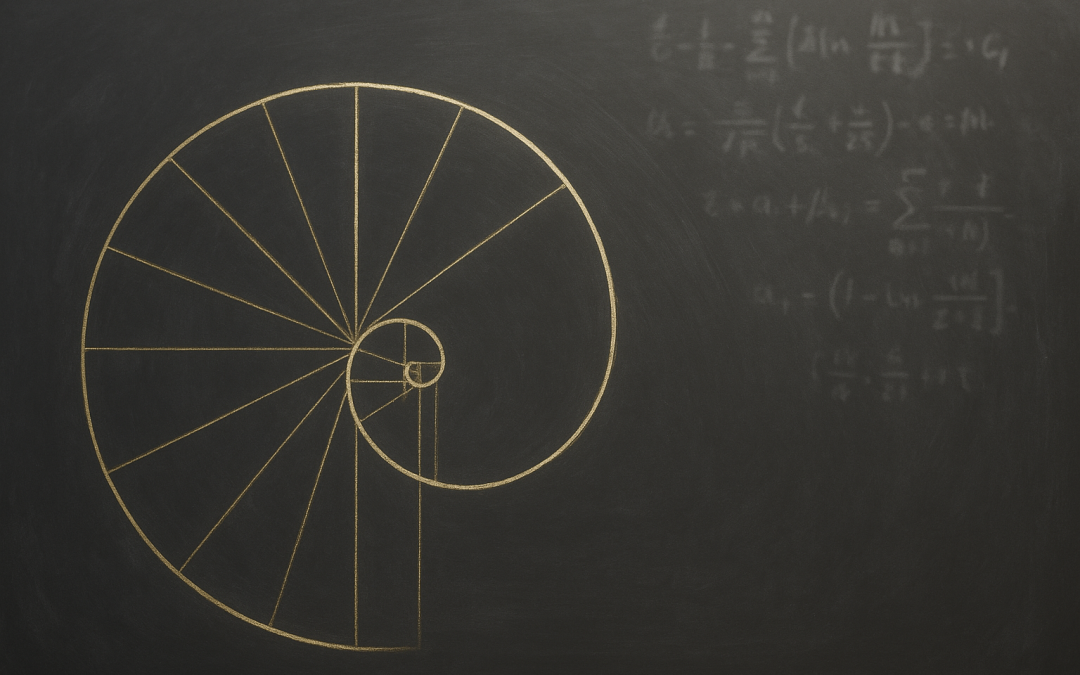
The binary radial formulation combines complementary internal and external sector triangles. The area kernel uses one internal contribution and two external contributions, unlike the circumference kernel’s two-to-one chord–tangent balance.
Geometric Elements
Resolve one Turn into N equal symmetric sectors. Let a be the internal triangle’s height, h half its chord, and e half the external tangent side. Define q = h/a.
$$ N=2^b,\quad b\ge2,\quad R>0,\qquad a^2+h^2=R^2,\quad e=R\frac ha. $$
Regular geometric bisection yields a scale bound. Together with the expansion, it proves second-order total error for the arithmetic kernel and fourth-order total error for the weighted kernel in exact arithmetic.
The earlier version introduced this quarter-step sampling parameter inside each module. The proof here concerns the complete sector triangles defined above. A different sample-based area construction requires its own explicit definition and proof.
Internal–external weights are reversed between the circumference and area kernels. This diagram is schematic; the triangle definitions determine the calculation.
Research Status
The cancellation is established for the regular triangular elements above. This does not establish original authorship of the weighting, numerical stability of an implementation, or a computational advantage. Those questions require separate literature and implementation comparisons.
Earlier revisions of this page described fourth-order behaviour as a candidate. The current analytical clarification identifies the geometric assumptions under which that behaviour follows.
A GRG Formulation: Circle and Area from a Binary Radial Framework
Generative Radial Geometry describes circular measures through a finite binary radial framework. Its working quantities are a radius, a full Turn, a binary resolution, and local chord–tangent constructions.
About the Current GRG Formulation
This page presents the documented binary radial formulation, with geometric definitions and an explicit verification of its measurement kernels. Earlier approaches, including Original Projection and previous Turns formulations, remain part of the research history.
The geometric construction, kernel accuracy, and computational efficiency are separate subjects. The analysis below establishes accuracy for regular symmetric sectors. It does not establish a performance advantage or prescribe an implementation.
The weighted area proposal is documented in A Symmetric GRG Kernel for Area. The geometric ratio notation and proofs below are an analytical clarification of the documented triangles and kernels.
Binary Turns and Resolution
A full rotation is one Turn. Resolve it into equal sectors. The nondegenerate chord–tangent formulas on this page require at least four sectors.
Let a be the distance from the centre to the internal chord, h half that chord, and e half the external tangent side. The tangent is perpendicular to the central radius. The two boundary rays intersect both the circle and this tangent.
$$ a^2+h^2=R^2,\qquad e=R\frac ha. $$
Figure 1 — Symmetric sector: internal chord, central radius, and external tangent side.
Define dimensionless ratios from these constructed lengths:
$$ c_b=\frac aR,\qquad s_b=\frac hR,\qquad q_b=\frac ha. $$
The weighting is a known local arc approximation. This formulation uses it as a kernel within the binary radial framework; the weighting itself is not claimed as an original GRG result.
Area Elements and Kernels
The internal triangle has base 2h and height a. The external triangle has base 2e and height R.
The following identity is used to verify regular equal-sector bisection. It is a geometric consequence, not an attribution of a particular numerical algorithm to GRG.
At four sectors the half-sector triangle has equal legs, so q₂ = 1. Bisecting its direction gives the following ratio, obtained by normalising the boundary direction and adding it to the central unit direction:
$$ q_{b+1}=\frac{q_b}{1+\sqrt{1+q_b^2}}. $$
The denominator is at least two. Induction therefore gives:
$$ 0\lt q_b\le 2^{2-b}=\frac4N. $$
This proves the scale bound needed for the global error estimates. It uses the regular bisection geometry; it does not require a precomputed full-Turn length or area.
Kernel Accuracy: Analytical Verification
Define the local integral below solely as an analytical reference for the exact sector measures. It is not an input to the measurement kernels.
$$ F(q)=\int_0^q\frac{dt}{1+t^2}. $$
Parameterising the circular boundary by its slope gives exact sector arc length 2RF(q) and exact sector area R²F(q). Thus the fixed full-Turn reference measures satisfy:
$$ C_T(R)=2NRF(q_b),\qquad A_T(R)=NR^2F(q_b). $$
$$ F(q)=q-\frac{q^3}{3}+\frac{q^5}{5}+O(q^7). $$
Substitution into the circumference kernels yields:
The area weighting cancels the cubic local residual. Combining these expansions with the geometric scale bound proves, for fixed radius and exact arithmetic:
Both derivatives are nonnegative for 0 ≤ q ≤ 1, which covers the sectors considered here. Consequently the bracket follows for every b ≥ 2, rather than only for tested resolutions.
The related area article specifies quarter-step sampling within a module. The verification above concerns the complete sector triangles. An implementation using internal samples must specify how those samples evaluate the same elements; the sampling parameter alone does not define an additional area kernel.
Figure 2 — Binary sector refinement at N = 4, 8, and 16.
Computational Efficiency and Research Scope
Binary resolution is compatible with binary angular indices and power-of-two scaling. A performance advantage for the complete calculation must nevertheless be measured.
A reproducible comparison must use equal accuracy targets, include generation or retrieval of the local measures, account for precomputation and memory, and specify arithmetic precision, rounding, hardware, and execution time. Stability in fixed-point arithmetic requires a separate error analysis.
The results established here concern the documented regular chord–tangent geometry and its kernels. Historical originality and implementation efficiency are separate investigations.
A discrete–exact grammar for curves and surfaces using turns, chords, and radial projections. π is not imported as a magic constant; it emerges from dyadic steps and converges in the classical limit.
.
Long-exposure light trails forming a radial bloom around a dark center; cool cyan and violet palette; bright, clear, high microcontrast; gentle glow; 16:9 horizontal; photorealistic; no people; no text or logos.
Turns-first definitions
We discretize the unit turn; dyadic refinement keeps operations exact on the mesh and drives accuracy.
$$
b \in \mathbb{N}_{\geq 0}, \qquad N = 2^{b}
$$
$$
\Delta u = 2^{-(b+2)} \quad \text{(quarter sampling)}
\qquad \Rightarrow \qquad
\Delta u = \frac{1}{4N}.
$$
For a circle of radius \(R\), the inscribed polygon at \(N\) turns has:
$$
P_{N} = 2 N R \sin\!\left(\frac{\pi}{N}\right),
\qquad
A_{N} = \frac{1}{2} N R^{2} \sin\!\left(\frac{2\pi}{N}\right).
$$
Turns, chords, and dyadic rays. Crisp vectors at any zoom.
Interactive Lab
Switch presets and adjust the dyadic exponent \(b\). For the star case \(r(\theta)=1+a\cos(k\theta)\), the exact area is \(A=\pi\!\left(1+\frac{a^{2}}{2}\right)\).
N (turns)
—
Perimeter (approx)
—
Area (approx)
—
Perimeter true
—
Area true
—
Errors (|P|, |A|)
—
Notes. Circle & atlas use exact finite-step formulas (chords) and converge monotonically. Star-shape uses inscribed polygons; C-shape uses odd–even radial sweep for area (perimeter shown exact for reference).
Critical FAQ (condensed)
Q: Is GRG just numerical integration with a trick? A: For circles with dyadic bisections steps are exact at finite \(N\) (chords & projections). The limit recovers classical values; nothing is imported.
Q: Where does \(\pi\) come from? A: From the discrete perimeter/area growth of dyadic polygons. \(\pi\) appears as a rotational-symmetry shadow as \(N\to\infty\).
Q: Non-convex shapes “jump across the outside”. A: We prevent that with visibility-aware schemes: (i) odd–even radial sweep; (ii) radial atlas (locally star-shaped patches with ± signs for outer components/holes).
Q: Convergence? A: \(O(N^{-2})\) for \(C^{2}\) boundaries; \(O(N^{-1})\) near corners (mitigated via adaptive dyadics). Inscribed perimeter/area are monotone.
Q: Why is GRG pedagogically useful? A: You can teach Euclidean geometry from bisections and chords; radians & trig tables emerge rather than being prerequisites.
Star-Check. If a center sees the whole boundary (star-shaped), sample \(\theta\) in dyadic turns and use \(r(\theta)\). Inscribed area/perimeter are monotone \(\uparrow\) with \(O(N^{-2})\).
Odd–Even radial sweep. For each \(\theta_{k}\), intersect the ray with the boundary, sort radii \(r_{k,j}\), and add inside segments \([r_{k,1},\, r_{k,2}],\ [r_{k,3},\, r_{k,4}], \dots\).
Radial atlas (± signs). Decompose into locally star-shaped patches; outer components \(+\), holes \(−\). Sum areas with signs and perimeters by absolute length. Same \(O(N^{-2})\) patch-wise.
Robustness. \(C^{2} \Rightarrow O(N^{-2})\); corners \(\Rightarrow O(N^{-1})\) unless adaptively refined. Self-intersections: use winding rule instead of parity.
All computations use turns, chords, projections; operations are exact at finite dyadic steps for circular primitives and exact on the mesh for polygons.
Team
Roles are presented by responsibility area. Individual bios can be added later.
Role-based structure. Short scope, clear ownership.
Leadership & Research
Sets the research agenda and publishes specifications with reproducible examples.
Maintains the “turns-first” glossary and consistency across demos and notes.
Approves public statements and abstracts before release.
Methods & Algorithms
Designs visibility-aware procedures (odd–even sweep, radial atlas with ± signs).
Owns convergence studies and baselines for circles, ellipses, and polygons.
Runs complexity/accuracy benchmarks; documents limits and mitigations.
Systems & Frontend
Implements interactive canvases; keeps demos accessible and performant.
Maintains build tooling and test fixtures for numerical correctness.
Coordinates localization and analytics (non-invasive, anonymized).
Editorial Review & QA
Checks clarity, tone, and scope; enforces the evidence-led style.
Validates formulas and captions (MathJax + SVG semantics and accessibility).
Controls versioning of figures; ensures non-repetitive hero imagery.
Collaborations
We welcome collaborations with educators and researchers. A public contact form will be added once finalized.
This FAQ clarifies how GRG treats circular geometry using turns (period-1 angles) and chords in a discrete, inside-out manner. Classical constants reappear as limits; they are not assumed as inputs.
What does “without π” really mean?
We do not claim a “π-less Euclidean geometry.” In GRG, π is not imported as a primitive; it emerges from a refinement process. At finite $N$, lengths and areas are computed with algebra (products and radicals) using turns and chords—no radians or pre-baked trig tables are required. In the limit, the classical constants reappear exactly.
Notation: let $s(u)$ denote the sine in turns, i.e. $s(u)=\sin(2\pi u)$. The chord corresponding to a step of $1/N$ turns on a circle of radius $R$ is
Isn’t this just numerical integration with a different skin?
Radial partition: pieces are internal chords/projections (not rectangular strips), naturally adapted to circular/elliptic symmetry.
Closed forms at finite $N$: for many $N$ (notably dyadics) you get nested radicals from geometric bisections—exact symbolic values, not only floats.
Monotone bounds & rate: inscribed/circumscribed constructions give clean bounds; the error decays like $O(N^{-2})$.
One grammar, many shapes: the same operators scale from rough to fine and extend to circles, ellipses, and spheres without changing the language.
So what is actually new?
The novelty is methodological and pedagogical: a single, discrete, inside-out grammar (turns, chords, projections) that does not import π/radians/trig as primitives, yet recovers them in the limit. Archimedean ideas are acknowledged; GRG reframes them for modern discrete computation and teaching.
Why do some diagrams mention “90°” if GRG uses turns?
Turns ($u\in[0,1)$) are the formal unit. Occasional “90°” labels are didactic visual cues for a quarter turn. All definitions and formulas are stated in turns and internal measures.
Pedagogical & computational takeaways
Conceptual clarity: learners see π emerge from an internal process rather than being assumed.
Computational simplicity: increase only $N$ to refine accuracy; same grammar from coarse to fine.
Extensibility: the approach transfers to ellipses and spheres with minimal changes to the operators.
Rate vs. step (dyadics)
With dyadic refinement $N=2^{b}$ (where $b$ is the number of bisections/bits), the turn step and the error scale as
Use the slider to vary $N$ on the unit circle ($R=1$). For an inscribed $N$-gon, both $P_N$ and $A_N$ are monotone increasing and stay below the true values ($2\pi$ and $\pi$).
Inscribed $N$-gon; chord $s_N=2\sin(\pi/N)$. Increase $N$ to see $P_N\!\nearrow 2\pi$ and $A_N\!\nearrow \pi$.
Dyadic refinement note: with $b\in\mathbb{N}_{\ge 0}$, $N=2^{b}$ gives especially clean nested-radical evaluations; quarter sampling uses $\Delta u=\tfrac{1}{4N}=2^{-b-2}$.
Paradigm Shift — Core Framing
GRG invites a change of lens: do not chase π; see the circle. Compute with the geometry directly (turns, dyadic refinement, additive projections). Where π appears, read it as a signature of circular symmetry — not a prerequisite for calculation.
Cause (circle) on the left; different shadows on the right. Perspective can mislead.
Myths & Facts
Myth: “You must use π to define or measure a circle.” Fact: GRG generates and measures the circle via a radial sweep with additive projections. π is a shadow of circular symmetry, not the ingredient.
Myth: “Discrete means coarse.” Fact: In GRG, discrete means targeted precision. You choose the resolution appropriate to purpose; refine dyadically when needed.
Myth: “Turns are just degrees renamed.” Fact: Turns compose cleanly with dyadic refinement and quarter-turn sampling, matching how GRG computes.
Short Answers (for the critical reader)
Q1. If π shows up in unrelated places (Wallis, ζ(2), Euler), what does GRG say?
Where π appears, a circular/rotational structure is at work — sometimes implicitly. GRG computes from the cause (the circle), then reads π as the signature of that structure, not as a required input.
Q2. How does GRG handle accuracy without limits or π-digits?
By resolution. You pick dyadic refinement and recompute; the method is stable and uniform across refinements. Precision is a knob, not an infinite chase.
Q3. Why “turns” first?
Because one full rotation is 1, halves and quarters are exact dyadic fractions, and sampling on a quarter-turn aligns with GRG’s construction.
Turns & Dyadic (at a glance)
$$
b \in \mathbb{N}_{\ge 0}, \quad N = 2^{\,b}, \quad \Delta u = 2^{-\,b-2}\ \text{(quarter-turn sampling)}.
$$
Increase b to double the resolution — same procedure, tighter result.
Prefer a quick recap of objections? Read the myths above, then continue with the full Critical FAQ below.
GRG — Objective Evaluation & FAQ
Generative Radial Geometry (GRG): reproducible results, comparisons with classical geometry, and clear answers to common objections.
Discrete-first construction
Product-only 2D
Turns (fractions of a full turn)
Principle: verifiable radial constructions
In GRG the radius is the generative object. Circumference and area emerge from radial sums over discrete turns. No claim of infallibility: for finite N the error is controlled; in the limit we recover classical values.
Key objections we answer with numbers
“Are you just approximating π?” → Yes, but in a constructive, controlled way.
Error order? → For smooth periodic integrands with trapezoids: O(N^{-2}).
Does it work in 3D? → Yes for spheres via latitude rings with regular convergence.
When not to use GRG? → Non–star-convex shapes and generic surfaces may require extensions.
Minimal toolkit & next experiments
GRG kernel/shader with adjustable turns.
Robot planner with radius as a state variable.
Radial length & area for star-convex profiles ρ(θ).
Review: rigor, clarity, reproducibility
Clean statements (no hype).
Explicit error bounds and assumptions.
Attach data & code (CSV, notebook, repo).
Figure — Ellipse circumference error; expected order ≈ 2.
For a circle of radius R, radial sums for circumference and area are (machine-)exact for any N: the integrand is constant, so rectangle/trapezoid rules reproduce the exact integral.
2D area: A \approx \tfrac{1}{2}\sum \rho(\theta_k)^2\,\Delta\theta.
Perimeter: L \approx \sum \sqrt{\rho_k^2 + \big(\tfrac{\Delta\rho}{\Delta\theta}\big)_k^2}\,\Delta\theta.
Sphere: A \approx \sum 2\pi R^2 \sin(\phi_j)\,\Delta\phi (midpoint).
Order: O(N^{-2}) for periodic C^2 integrands (trapezoids/midpoints).
$$
\text{Turns-first:}\quad b \in \mathbb{N}_{\ge 0},\quad N = 2^{\,b},\quad \Delta u = 2^{-b-2}
$$
Frequently Asked Questions
“Are you just approximating π in another way?”
Yes, but with a constructive and controlled method: some quantities (circle) are exact at finite N; for smooth periodic integrands the error decays as O(N^{-2}). π reappears as a property, not as an input.
“What is the error order?”
With the trapezoidal rule on a uniform periodic grid and a C^2 integrand, we get O(N^{-2}). See charts and CSVs.
“Does it work in 3D?”
For the sphere, midpoint latitude-ring summation converges to 4\pi R^2 with order ≈ 2. Generic surfaces require metric extensions.
“When should I avoid GRG?”
Non–star-convex shapes and complex surfaces may need multi-valued \rho(\theta) or alternative parameterizations; classical/hybrid methods can be preferable there.
“Where are the code and data?”
This demo links the CSVs of our experiments. For public replication, attach a repository (e.g., Zenodo DOI) and a notebook that regenerates all figures.
The current formulation defines regular equal sectors, local chord–tangent lengths, triangular areas, and weighted kernels. Its proofs concern those definitions.
A runnable method must identify initial values, refinement or direct evaluation, arithmetic format, outputs, and stopping conditions. A geometry identity alone is not a runtime benchmark.
Extensions
Adaptive sampling, general curves, multiple seeds, and three-dimensional constructions require their own definitions and validation. No error order or performance advantage is transferred automatically from the regular-circle proof.
To provide the best experiences, we use technologies like cookies to store and/or access device information. Consenting to these technologies will allow us to process data such as browsing behavior or unique IDs on this site. Not consenting or withdrawing consent, may adversely affect certain features and functions.
Functional
Always active
The technical storage or access is strictly necessary for the legitimate purpose of enabling the use of a specific service explicitly requested by the subscriber or user, or for the sole purpose of carrying out the transmission of a communication over an electronic communications network.
Preferences
The technical storage or access is necessary for the legitimate purpose of storing preferences that are not requested by the subscriber or user.
Statistics
The technical storage or access that is used exclusively for statistical purposes.The technical storage or access that is used exclusively for anonymous statistical purposes. Without a subpoena, voluntary compliance on the part of your Internet Service Provider, or additional records from a third party, information stored or retrieved for this purpose alone cannot usually be used to identify you.
Marketing
The technical storage or access is required to create user profiles to send advertising, or to track the user on a website or across several websites for similar marketing purposes.