
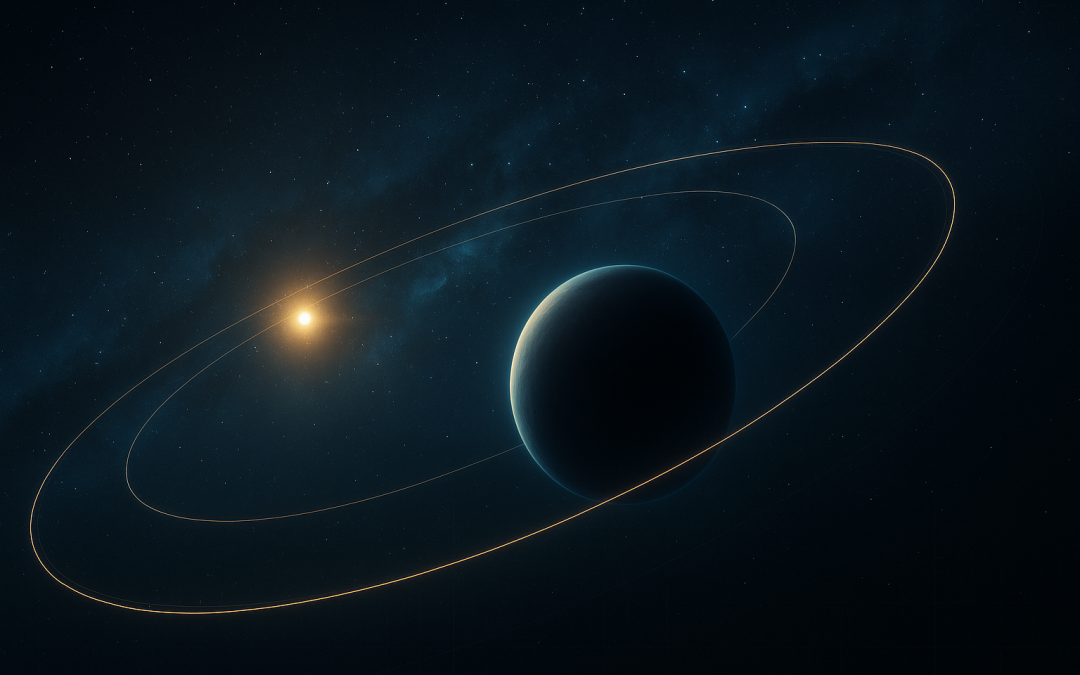
GRG for ellipses
GRG for Ellipses — Constructive Area, Perimeter, and Equal-Area Sectors
The “Variable Radius” in GRG
The effective radius depends on the chosen direction.
-
From the center (angle \(\phi\) from the major axis):
$$ r_c(\phi)=\frac{ab}{\sqrt{(b\cos\phi)^2+(a\sin\phi)^2}}. $$ -
From the focus (true anomaly \(\theta\)):
$$ r_f(\theta)=\frac{p}{1+e\cos\theta},\qquad e=\sqrt{1-\frac{b^2}{a^2}},\qquad p=\frac{b^2}{a}. $$ -
Without trigonometry (slope \(m=\tan\phi\)):
$$ r_c(m)=\frac{ab\,\sqrt{1+m^2}}{\sqrt{\,b^2+a^2m^2\,}}. $$
Ellipse Area in GRG
A1) Cartesian strips in the first quadrant
Split the semi-axis \(a\) into \(N\) parts: \(x_i=i\,a/N\) with \(\Delta x=a/N\). Heights \(y_i=b\sqrt{1-x_i^2/a^2}\).
A2) Radial wedges from the center (by quarters)
With \(\Delta\phi=90^\circ/N\) and \(\phi_i=i\,\Delta\phi\):
A3) Radial wedges from the focus (natural for orbits)
With \(\Delta\theta=360^\circ/M\) and \(\theta_i=i\,\Delta\theta\):
Perimeter (sum of chords)
P1) Chords from the center (by quarters)
With \(\Delta\phi=90^\circ/N\):
P2) Chords from the focus (full ellipse)
GRG Error Estimate (after-the-fact)
With step doubling the error typically decays ~quadratically. Method-agnostic (π-free):
Compute \(S_N\) and \(S_{2N}\) with the same operator (A1–A3, P1–P2).
Accelerated approximation:
$$ S_\star \approx S_{2N}+\frac{S_{2N}-S_N}{3}. $$Error estimate:
$$ \varepsilon \approx \frac{|S_{2N}-S_N|}{3}. $$
Practical Pipeline (geometry → orbits)
Geometry: use A1 or A2 for area and P1 for perimeter with quarter symmetry.
Orbits: use A3. For uniform time steps, enforce constant-area sectors:
$$ \tfrac12\,r_f(\theta_k)\,r_f(\theta_{k+1})\,\sin(\theta_{k+1}-\theta_k)=\Delta A. $$The arc length per step is the P2 chord between successive points.