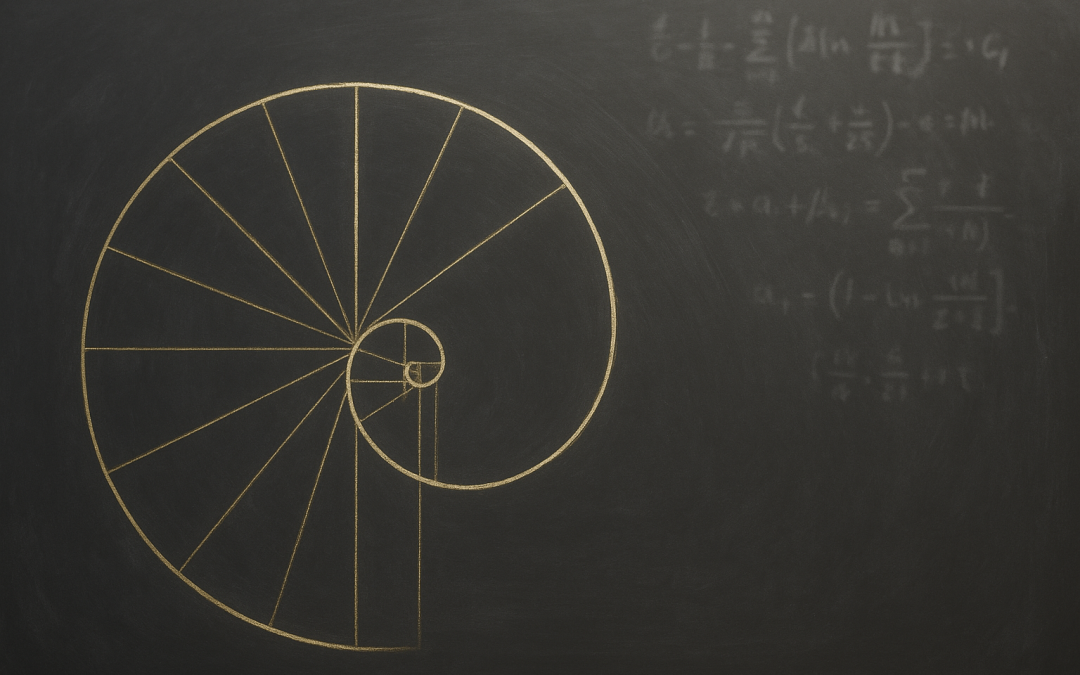
The current formulation defines regular equal sectors, local chord–tangent lengths, triangular areas, and weighted kernels. Its proofs concern those definitions.
A runnable method must identify initial values, refinement or direct evaluation, arithmetic format, outputs, and stopping conditions. A geometry identity alone is not a runtime benchmark.
Extensions
Adaptive sampling, general curves, multiple seeds, and three-dimensional constructions require their own definitions and validation. No error order or performance advantage is transferred automatically from the regular-circle proof.
This page preserves an earlier formulation or research method. Its notation, formulas, and embedded demonstrations belong to that version and should not be treated as the specification of the current binary radial kernels.
Read the current formulation and its analytical verification. Historical performance statements and implementation behaviour require separate validation. Earlier references to circular constants remain in this historical document; they are not inputs to the current geometric kernel definitions.
GRG measures angles in turns with period‑1 primitives c(u), s(u) (no π assumed in discrete steps). Constructions proceed on quarters/sectors, summing center‑seeded primitives (chords and radial strips). Below are the core identities used across methods.
Turns Trigonometry (period‑1)
Let a full rotation be one turn. The functions c(u), s(u) are period‑1 and satisfy the usual symmetries and addition rules:
Rule choice (midpoint / right‑endpoint / averaged) governs bias for arc length; strip areas use the exact triangle formula per step, remaining π‑free at finite N.
Left: chord and sagitta for step Δu. Right: one center‑seeded strip with area ½·s(Δu).
Background & Positioning
Category: Generative Radial Geometry (GRG)
Generative Radial Geometry (GRG) builds shapes from the inside via discrete radial scans. Measurements arise by summing chords and radial trapezoids without assuming π in advance. Angles are measured in turns (period‑1), using primitives c(u), s(u) with u \in [0,1). We present GRG as a digital‑native (2025) center‑seeded approach—π‑free and complementary to classical, formula‑first geometry.
Motivation
Classical geometry is top‑down, continuous, formula‑centric. GRG is inside‑out: pick a resolution N, rotate a central ray with step Δu, and accumulate discrete contributions that converge as N grows.
Key Idea (Quarter Aggregation)
Build a quarter from center‑seeded primitives, then use symmetry.
Quarter arc length follows from summing chords (upper/lower/midpoint/average rules). Area uses radial trapezoids on the quarter, scaled ×4. The one‑step sagitta is
Quarter with chord (orange), sagitta (dashed), and one radial trapezoid (blue).
π as an Emergent Limit (in turns)
Let the full polygon have N chords with Δu = 1/N. The chord between consecutive samples is 2·s(Δu/2), hence the polygon perimeter is C_N = 2N·s(1/(2N)). Define π (in turns) as half the circumference of the unit circle. Then:
Original Projection, Cartesian trapezoidal methods, and earlier Turns formulations retain their own definitions and scope. They are not interchangeable specifications.
Evidence
Geometric accuracy, floating-point stability, computational performance, and originality are separate questions. See Results and the benchmark protocol for their status.
GRG — Looking from the Inside: a discrete, π-free language for shapes
Generative Radial Geometry (GRG) — Looking from the Inside
GRG conventions. Angles are measured in turns \(u\in[0,1)\).
Radial computations (perimeter and radial area) run on the full turn;
the Cartesian area uses the quarter (and then ×4).
Trigonometric forms are optional cross-checks, not inputs to the pipeline.
Work-in-progress. GRG is a discrete, π-free way to measure and compare shapes by radial generation. The turning point was this: I looked at the circle from its inside—a point that sends rays outward and measures what they meet. That inside→out switch is small to say and large to practice. The door is open; we will walk through it.
Why GRG matters
Discrete by nature: everything runs in finite steps (N)—heights, chords, bands.
π-free computation: the pipeline never needs π to run; π appears only when we compare to classical values.
Immediate comparability: two shapes at the same resolution are directly comparable with the same grammar.
Multi-scale: increase N; the very same procedure refines itself (coarse → fine).
GPU-friendly: short loops and sums, ideal for digital geometry, CAD/graphics, and simulation.
Looking from the inside
Not from a grid of squares, not from external coordinates—from a center that emits rays. A shape becomes a radial profile (a finite vector of values) rather than a formula to solve. From there, measurement and comparison happen discretely and immediately.
The joined method (circle)
Perimeter (radial, full turn): split the full turn \(u\in[0,1)\) into \(4N\) equal steps \(\Delta u=1/(4N)\).
Join successive GRG border nodes by chords; the quarter view in the figure is for clarity.
Area (Cartesian, quarter): split one radius into \(N\) parts; at each split, drop the perpendicular to the circle (the “height”).
Adjacent heights form a trapezoid; summing them tiles the quarter of a disk (the last one degenerates to a triangle). Multiply by 4 for the full disk.
Figure — joined method (circle)
Blue = angular sectors (perimeter, shown on the quarter). Red = single-radius trapezoids (area on the quarter). Dashed red rays start from the height intersections and generally do not coincide with the blue rays.
Figure 1. Quarter circle built from angular sectors (blue) and single-radius trapezoids (red); dashed rays start at height intersections.
Discrete comparability (the practical power)
At the same resolution N, any two shapes share the same grammar (heights, chords). This makes them comparable immediately—π-free inside the computation. We use simple, discrete indices relative to a baseline circle at the same N:
Area Index \(a_N\)
Perimeter Index \(c_N\)
Isoperimetric-like ratio \(q_N=a_N/c_N^2\) (the circle maps to 1 at the same N)
Minimal math — turns-first (π-free, node-based)
Quarter nodes (turns):
\[
\Delta u \;=\; \frac{1}{4N}
\]
\[
u_k \;=\; k\,\Delta u \quad (k=0,\dots,N)
\]
Cartesian area (quarter, Δx) — same as above, then ×4.
Figure — 3D comparator (hemisphere bands)
Clean comparator for surfaces: baseline hemisphere on the left, target surface on the right. Blue = GRG parallels on each latitude; red = bands (average of neighboring circumferences). Below, π-free indices (schematic bars).
Figure 2. Hemisphere bands comparator: left = baseline, right = target. Blue parallels indicate perimeter along latitude; red band shows area via average neighboring circumferences times slant. Bars below sketch π-free indices.
From the circle to the sphere (concept)
We stack latitude bands along the vertical axis and apply the same grammar on each parallel (GRG circumference on the band’s ends, averaged across the slant). Errors shrink fast with balanced vertical and angular splits. The comparator above is designed to show differences band-by-band without clutter.
Applications
Graphics/CAD: π-free arc lengths and areas that run fast and parallel.
Sampling/tiling on spheres: controllable bands, equal-area approximations.
Gear-like and elliptical profiles via directional radial generation.
Education: a concrete bridge from discrete geometry to classical values.
Status & invitation
GRG is young and grows with this site. The aim is simple: a practical, comparable, discrete language for shapes and surfaces. If the idea helps, let’s refine proofs, diagrams, and applications together.
To provide the best experiences, we use technologies like cookies to store and/or access device information. Consenting to these technologies will allow us to process data such as browsing behavior or unique IDs on this site. Not consenting or withdrawing consent, may adversely affect certain features and functions.
Functional
Always active
The technical storage or access is strictly necessary for the legitimate purpose of enabling the use of a specific service explicitly requested by the subscriber or user, or for the sole purpose of carrying out the transmission of a communication over an electronic communications network.
Preferences
The technical storage or access is necessary for the legitimate purpose of storing preferences that are not requested by the subscriber or user.
Statistics
The technical storage or access that is used exclusively for statistical purposes.The technical storage or access that is used exclusively for anonymous statistical purposes. Without a subpoena, voluntary compliance on the part of your Internet Service Provider, or additional records from a third party, information stored or retrieved for this purpose alone cannot usually be used to identify you.
Marketing
The technical storage or access is required to create user profiles to send advertising, or to track the user on a website or across several websites for similar marketing purposes.