
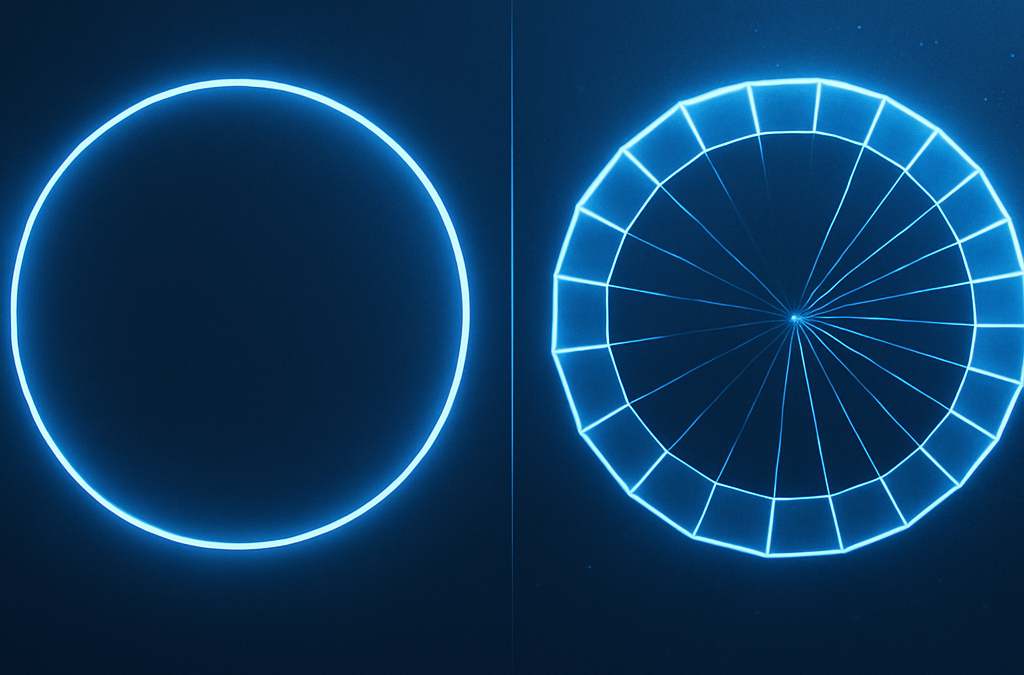
Radius, Rotation, Arc
Generative Radial Geometry: Radius, Rotation, and Arc Length
Generative Radial Geometry (GRG) provides a discrete, π-free, constructive method to generate circles, spheres, and related shapes. Instead of assuming π and continuous formulas, GRG builds geometry from radial divisions, summing chords and trapezoids. This creates a radically different perspective compared to the classical approach. Angles are expressed as fractions of the turn ($u\in[0,1)$).
Why GRG Matters
Classical geometry relies on π and continuous trigonometric functions. GRG, in contrast, is digital-native: it works with finite steps, exact points on the circumference, and simple arithmetic operations. This makes it both conceptually new and computationally efficient.
Core Comparison
The table below highlights the key differences between the two approaches.
| Aspect | Classical Approach | Generative Radial Geometry (GRG) |
|---|---|---|
| Definition of angle | Radians \((s=r\theta)\) with \(\pi\). | Angle = discrete fraction \(k/N\) of the turn \((u\in[0,1))\), generated internally. |
| Mathematical tools | Trigonometry, sine/cosine, continuous integrals. | Finite sums of chords and trapezoids; additions and square roots. |
| Points on the circle | Require trig functions (numerically approximated). | Exact by construction on generated radial sets \((x^2+y^2=R^2)\). |
| Lengths and areas | Closed forms: \(s=r\theta\), \(A=\pi R^2\). | Generated sums: \(L=\sum \ell_i\), \(A=\sum A_i\); \(\pi\) emerges as a limit. |
| Local error | None in theory, but depends on \(\pi\)/trig numeric precision. | Error only from finite sums; boundary points remain exact. |
| Extension to 3D | New formulas needed (e.g., \(V=\tfrac{4}{3}\pi R^3\)). | One constructive scheme extends to surfaces and volumes. |
| Computational efficiency | Expensive trig; slower on low-level hardware. | Roots + sums; friendly to SIMD/GPU and embedded devices. |
| Concept of \(\pi\) | \(\pi\) assumed a priori. | \(\pi\) appears from the discrete generative process. |
| Conceptual view | Geometry as a static entity to be measured. | Geometry as an internal, generative process. |
Three GRG Modes
On this page we use three operational modes. Two are Cartesian and compute area on a quarter (by symmetry). One is radial and computes circumference on the full turn.
| Mode | Target | Partition | Element | Estimate | Formula (sketch) | Notes |
|---|---|---|---|---|---|---|
| Δx Trapezoidal (Cartesian) | Area | Quarter, \(x_i=i\,\Delta x\), \(\Delta x=R/N\) | Trapezoids between heights \(h_i=\sqrt{\,R^2-x_i^2\,}\) | Lower (under-tiling) | \(A_Q \approx (\Delta x/2)\sum(h_i+h_{i+1})\); total area \(=4\,A_Q\) | Monotone ↑ with \(N\) |
| Projection Corridor (Cartesian) | Area | Quarter, same \(\Delta x\) | Riemann-like bars at right / midpoint | Lower/Upper (squeezing) | \(A_Q^{\downarrow}=\Delta x\sum h_i\), \(A_Q^{\uparrow}=\Delta x\sum h_{i+\tfrac12}\); total \(=4\times\) | Certified bounds |
| Chord-Sum at \(\Delta u\) (Radial) | Circumference | Full turn, \(\Delta u=1/N\) | Chords between consecutive radial points | Lower (inscribed polygon) | \(L \approx N\,R\,\sqrt{\,2-2\,c(1/N)\,}\) | No quarter; defined on the whole circle |
Further Evaluations & Options
- Certified area bounds. The corridor (right vs midpoint) yields lower/upper bounds that squeeze the exact area as \(N\) grows.
- Stronger circumference bracketing. Pair the inscribed chord-sum (lower) with a circumscribed tangent-sum (upper) to bound the true length.
- Adaptive refinement. Increase \(N\) only where variation is largest (near endpoints for Cartesian area; uniform \(\Delta u\) usually suffices for chords).
- Hybrid pipelines. Use circumference from chords to cross-check the discrete derivative of area w.r.t. \(R\).
- 3D extension. The same logic generalizes to spherical belts (length) and frusta/patch sums (area/volume) with discrete radial partitions.
- Hardware efficiency. All modes need only sums and square roots → ideal for embedded, SIMD, and GPU kernels.
Conclusions
Classical geometry excels in closed-form elegance. GRG complements it with a digital-native, constructive view: exact boundary points, sums that converge without assuming π, and a single scheme that scales from 2D to 3D. Here we use three GRG modes—two Cartesian for area on a quarter, one radial for circumference on the full turn—unlocking certified bounds, adaptive strategies, and hardware-friendly implementations.