Foundations

Foundations

Document Status and Current Reference

This page preserves an earlier formulation or research method. Its notation, formulas, and embedded demonstrations belong to that version and should not be treated as the specification of the current binary radial kernels.

Read the current formulation and its analytical verification. Historical performance statements and implementation behaviour require separate validation. Earlier references to circular constants remain in this historical document; they are not inputs to the current geometric kernel definitions.

Mathematical Foundations: Turns Trigonometry & Radial Discretization

Category: Generative Radial Geometry (GRG)

GRG measures angles in turns with period‑1 primitives c(u), s(u) (no π assumed in discrete steps). Constructions proceed on quarters/sectors, summing center‑seeded primitives (chords and radial strips). Below are the core identities used across methods.

Turns Trigonometry (period‑1)

Let a full rotation be one turn. The functions c(u), s(u) are period‑1 and satisfy the usual symmetries and addition rules:

$$ c(u+1)=c(u),\quad s(u+1)=s(u),\quad c(-u)=c(u),\quad s(-u)=-s(u) $$
$$ c(u+v)=c(u)c(v)-s(u)s(v),\qquad s(u+v)=s(u)c(v)+c(u)s(v) $$

Quarter symmetry and parity yield the relations needed for GRG’s inside‑out sums, without introducing π in the discrete formulas.

Chord, Sagitta, and Radial Strip Area

For a unit circle with step Δu between consecutive samples u_L and u_R=u_L+Δu:

$$ \operatorname{chord}(\Delta u)=2\,s\!\left(\tfrac{\Delta u}{2}\right) $$
$$ \operatorname{sagitta}(\Delta u)=1-c\!\left(\tfrac{\Delta u}{2}\right) $$

The area of the center‑seeded strip (triangle O–p(u_L)–p(u_R)) equals half the cross‑product magnitude, i.e. a period‑1 sine of the step:

$$ A_{\text{strip}}(\Delta u)=\tfrac{1}{2}\,\Big(c(u_L)\,s(u_R)-s(u_L)\,c(u_R)\Big) =\tfrac{1}{2}\,s(\Delta u) $$

Discrete Perimeter and Area on a Quarter

With uniform steps Δu=\tfrac{1}{4N} on a quarter (N samples):

$$ P_{\tfrac14}(N;\text{rule})=\sum_{k=1}^{N}\operatorname{chord}(\Delta u),\qquad P(N)=4\,P_{\tfrac14}(N;\text{rule}) $$
$$ A_{\tfrac14}(N)=\sum_{k=1}^{N}\tfrac{1}{2}\,s(\Delta u)=\tfrac{N}{2}\,s\!\left(\tfrac{1}{4N}\right),\qquad A(N)=4\,A_{\tfrac14}(N) $$

Rule choice (midpoint / right‑endpoint / averaged) governs bias for arc length; strip areas use the exact triangle formula per step, remaining π‑free at finite N.

π as an Emergent Limit (turns)

From the full polygon with Δu=1/N:

$$ \pi=\lim_{N\to\infty} N\,s\!\left(\tfrac{1}{2N}\right) $$

Background & Positioning

Category: Generative Radial Geometry (GRG)

Generative Radial Geometry (GRG) builds shapes from the inside via discrete radial scans. Measurements arise by summing chords and radial trapezoids without assuming π in advance. Angles are measured in turns (period‑1), using primitives c(u), s(u) with u \in [0,1). We present GRG as a digital‑native (2025) center‑seeded approach—π‑free and complementary to classical, formula‑first geometry.

Motivation

Classical geometry is top‑down, continuous, formula‑centric. GRG is inside‑out: pick a resolution N, rotate a central ray with step Δu, and accumulate discrete contributions that converge as N grows.

Key Idea (Quarter Aggregation)

Build a quarter from center‑seeded primitives, then use symmetry.

$$\operatorname{chord}(\Delta u)=2\, s\!\left(\tfrac{\Delta u}{2}\right)$$

Quarter arc length follows from summing chords (upper/lower/midpoint/average rules). Area uses radial trapezoids on the quarter, scaled ×4. The one‑step sagitta is

$$\operatorname{sagitta}(\Delta u)=1-c\!\left(\tfrac{\Delta u}{2}\right)$$

π as an Emergent Limit (in turns)

Let the full polygon have N chords with Δu = 1/N. The chord between consecutive samples is 2·s(Δu/2), hence the polygon perimeter is C_N = 2N·s(1/(2N)). Define π (in turns) as half the circumference of the unit circle. Then:

$$\pi \,=\, \lim_{N\to\infty} N\, s\!\left(\tfrac{1}{2N}\right)$$

Dyadic variant: letting N = 2^B, we also have π = lim_{B→∞} 2^{B}·s(2^{-(B+1)}).

What GRG Adds

  • Deterministic control: explicitly choose N, the step Δu, and the rule (midpoint / right‑endpoint / average / radial‑trapezoidal Δu).
  • Turns‑based formalism: period‑1 trigonometry with c(u), s(u); quarter aggregation unifies perimeter and area.
  • Inside‑out convergence: measurements as discrete sums of center‑seeded primitives.

Page Takeaways

  • GRG is a center‑seeded, π‑free discretization framework (2025).
  • Angles are measured in turns with period‑1 primitives c(u), s(u).
  • Quarter aggregation gives simple, reproducible formulas for perimeter and area.

Overview

Overview

GRG Overview

Generative Radial Geometry studies finite radial constructions and their measurement kernels. The current two-dimensional reference uses equal binary sectors, internal chord triangles, and external tangent triangles.

Current Reference

Definitions, kernel formulas, bounds, and exact-arithmetic error proofs.

Research History

Original Projection, Cartesian trapezoidal methods, and earlier Turns formulations retain their own definitions and scope. They are not interchangeable specifications.

Evidence

Geometric accuracy, floating-point stability, computational performance, and originality are separate questions. See Results and the benchmark protocol for their status.

Turns & Precision

Turns & Precision

Turns & Precision

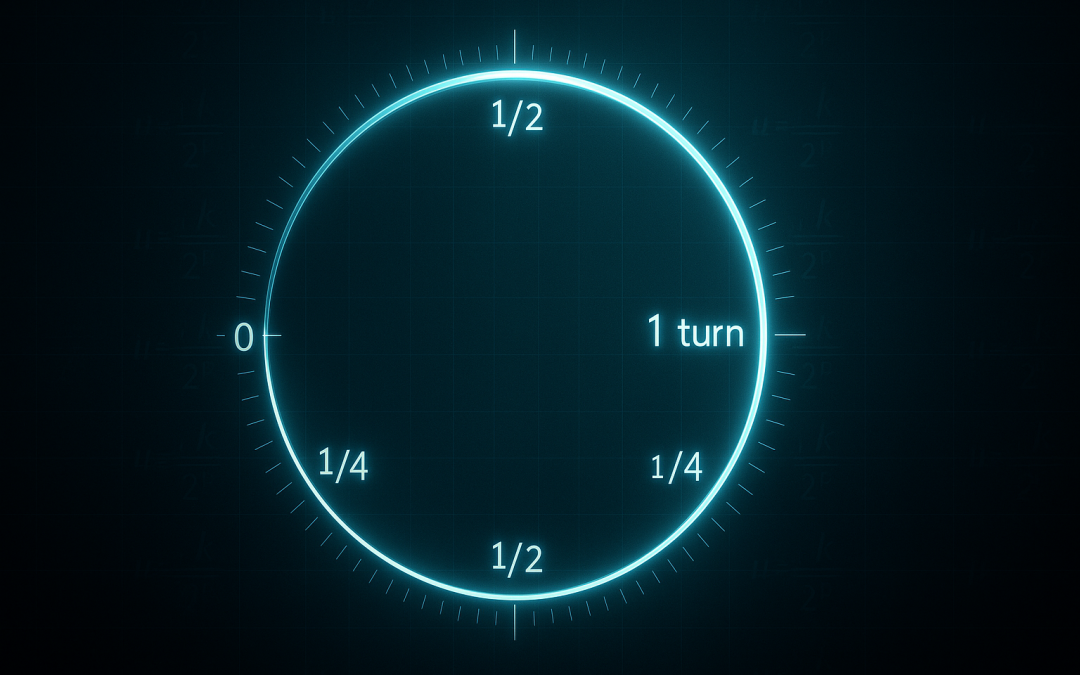
This page formalises the angle unit used across ERG/GRG. Angles are measured in turns (fractions of a full rotation). We also define a binary fixed-point representation for hardware/software precision.

Angle unit (turns)

A full rotation is \(1\) turn. Quarter-turn \(= \tfrac{1}{4}\), half-turn \(= \tfrac{1}{2}\), etc. Trigonometric functions are period-1 in turns: \(c(u),\, s(u)\) with \(c(0)=1,\ s(0)=0,\ c(\tfrac{1}{4})=0,\ s(\tfrac{1}{4})=1\).

Equal-angle partition (N sectors)

Choose the number of sectors \(N\) and set the step \(\Delta u = \tfrac{1}{N}\). Sampling angles: \(u_k = \tfrac{k}{N}\), \(k=0,\dots,N-1\).

Binary fixed-point turns (B bits)

Store angles as \(u = \tfrac{k}{2^{B}}\) turns with \(k \in \{0,\dots,2^{B}\!-\!1\}\). The angular resolution is \(\Delta u_B = 2^{-B}\). To get exactly \(N\) equal sectors, pick \(N\) dividing \(2^{B}\) (e.g. \(N=2^{B}\)). Then use indices \(k = m\,j\) with \(m = \tfrac{2^{B}}{N}\), \(j=0,\dots,N-1\).

0 1/8 1/4 3/8 1/2 5/8 3/4 7/8
Example with \(B = 3\) bits ⇒ \(2^{3}=8\) ticks. Increasing \(B\) doubles the ticks and the precision.

Why more bits ⇒ more accuracy

  • Circumference (chords): \( C_N \;=\; 2\,N\,r\, s\!\bigl(\tfrac{1}{2N}\bigr) \) is the inscribed \(N\)-gon perimeter; as \(N\) doubles, the step halves and the error typically drops ≈ \(\times 4\).
  • Area (sectors): \( A_N \;=\; \tfrac{N}{2}\,r^{2}\, s\!\bigl(\tfrac{1}{N}\bigr) \) behaves similarly (step-squared).

Quick reference

Inline: \( \Delta u = \tfrac{1}{N},\quad u_k = \tfrac{k}{N},\quad u = \tfrac{k}{2^{B}},\quad \Delta u_{B} = 2^{-B} \).
Display:

$$ C_{N} \;=\; 2\,N\,r\, s\!\Bigl(\frac{1}{2N}\Bigr), \qquad A_{N} \;=\; \frac{N}{2}\,r^{2}\, s\!\Bigl(\frac{1}{N}\Bigr). $$

Implementation notes

  • Keep an angle register \(k\) modulo \(2^{B}\) (wrap-around on \(B\) bits).
  • For LUTs of size \(2^{M}\) with \(M \le B\), index by \(k \gg (B-M)\).
  • Step-doubling check: compare \(N\) vs \(2N\) to gauge the remaining gap.
The Circle

The Circle

The Circle — Radius-First (Three Methods)

Principle

The circle is generated from the center. The radius is the only primitive; the perimeter is the path traced by the radius, and the area is the surface swept by its rotation. We work in turns (fractions of a full rotation), not in sexagesimal degrees.

Angles in turns & radial node

Let \(u\in[0,1)\) be an angle in turns (period \(1\)). We use period-1 trigonometric functions \(c(u), s(u)\) with \(c(0)=1, s(0)=0\) and \((c(\tfrac14), s(\tfrac14))=(0,1)\). The exact radial node is:

$$ P(u)=\bigl(r\,c(u),\; r\,s(u)\bigr). $$

Bit-friendly turns

Use fixed-point angles \(u = k/2^B\). Picking \(N\) that divides \(2^B\) makes equal-angle steps exact (\(\Delta u=1/N\)).
Optional: LUT + interpolation for \(c(u), s(u)\).

Method scope & scaling (quick key)

  • Radial Sectors (equal-angle, full turn) → no ×4.
  • Δx Trapezoidal (quarter tiling) → ×4 to get the full circle.
  • Original Projection (midpoint/right on a quadrant) → ×4.
Perimeter (equal-angle chords) is naturally full-turn (no ×4) and shared across methods.

Perimeter (shared across methods)

Equal-angle chords (full turn)

$$ \boxed{\, C_N \;=\; 2\,N\,r\,s\!\Bigl(\tfrac{1}{2N}\Bigr) \,} $$
Inscribed regular \(N\)-gon in turns. Monotone ↑ in \(N\). No quadrant scaling.
Perimeter by equal-angle chords (Δu = 1/N turns) Cartesian axes; circle r=100; sample radii and dashed chords (example N=12).
Perimeter by equal-angle chords: \(C_N = 2N r\, s(1/(2N))\) (full turn).

Area — three interchangeable builds (pick one)

Δx Trapezoidal (quarter → ×4)

$$ \Delta x=\frac{r}{N},\quad x_k=k\,\Delta x,\quad y_k=\sqrt{r^2-x_k^2} $$
$$ A_{\text{quarter}}(N)=\frac{\Delta x}{2}\!\left(y_0+2\sum_{k=1}^{N-1}y_k+y_N\right),\qquad A(N)=4\,A_{\text{quarter}}(N). $$
Under-approx on a concave arc; smooth convergence \(O(N^{-2})\).

Original Projection (midpoint/right corridor, quarter → ×4)

$$ \Delta x=\frac{r}{N},\ \ x_{k+\tfrac12}=(k+\tfrac12)\Delta x,\ \ y(x)=\sqrt{r^2-x^2} $$
$$ A^{\text{quad}}_{\text{mid}}=\sum_{k=0}^{N-1} y\!\bigl(x_{k+\tfrac12}\bigr)\,\Delta x,\qquad A^{\text{quad}}_{\text{right}}=\sum_{k=0}^{N-1} y\!\bigl(x_{k+1}\bigr)\,\Delta x, $$
$$ A_{\text{mid/right}}=4\,A^{\text{quad}}_{\text{mid/right}},\qquad A_{\text{right}}\le A_{\text{true}}\le A_{\text{mid}}. $$
Midpoint is second-order; corridor shrinks with \(N\).

Radial Sectors (equal-angle sectors, full turn)

$$ \boxed{\, A_N = \tfrac{N}{2}\,r^2\,s\!\Bigl(\tfrac{1}{N}\Bigr) \,} $$
Sum of \(N\) congruent isosceles triangles with included angle \(1/N\) turns (inscribed lower; monotone ↑ in \(N\)). No ×4.
Quarter area by Δx trapezoids (under the arc) Cartesian x–y axes; quarter arc with Δx verticals and interior trapezoids. Δx trapezoids
Quarter area by Δx trapezoids; multiply by 4 for the full circle.
Radial sector tiling (equal-angle sectors, full turn) Two example sectors on a unit circle (illustrative N=8).
Radial sectors: \(A_N=\tfrac{N}{2}r^2\,s(1/N)\) (full turn, no ×4).

Practical notes

  • Pick \(N\). If angles are \(k/2^B\) turns, choose \(N\mid 2^B\). Use step-doubling (\(N\!\to\!2N\)) to gauge the gap.
  • Monotonicity. \(C_N\) ↑ with \(N\). Δx trapezoids ↑ toward area (under-tiling). Original corridor shrinks. Radial sectors ↑ (inscribed).
  • All in turns. No degrees, no π in the constructive steps.