Turns & Precision

Turns & Precision

Turns & Precision

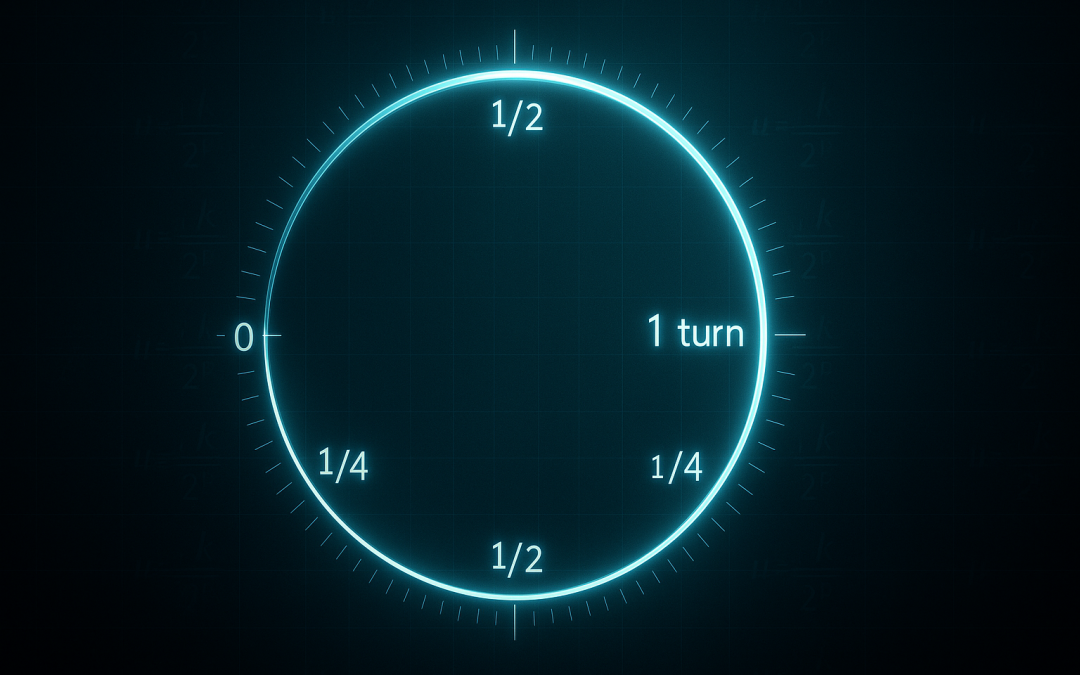
This page formalises the angle unit used across ERG/GRG. Angles are measured in turns (fractions of a full rotation). We also define a binary fixed-point representation for hardware/software precision.

Angle unit (turns)

A full rotation is \(1\) turn. Quarter-turn \(= \tfrac{1}{4}\), half-turn \(= \tfrac{1}{2}\), etc. Trigonometric functions are period-1 in turns: \(c(u),\, s(u)\) with \(c(0)=1,\ s(0)=0,\ c(\tfrac{1}{4})=0,\ s(\tfrac{1}{4})=1\).

Equal-angle partition (N sectors)

Choose the number of sectors \(N\) and set the step \(\Delta u = \tfrac{1}{N}\). Sampling angles: \(u_k = \tfrac{k}{N}\), \(k=0,\dots,N-1\).

Binary fixed-point turns (B bits)

Store angles as \(u = \tfrac{k}{2^{B}}\) turns with \(k \in \{0,\dots,2^{B}\!-\!1\}\). The angular resolution is \(\Delta u_B = 2^{-B}\). To get exactly \(N\) equal sectors, pick \(N\) dividing \(2^{B}\) (e.g. \(N=2^{B}\)). Then use indices \(k = m\,j\) with \(m = \tfrac{2^{B}}{N}\), \(j=0,\dots,N-1\).

0 1/8 1/4 3/8 1/2 5/8 3/4 7/8
Example with \(B = 3\) bits ⇒ \(2^{3}=8\) ticks. Increasing \(B\) doubles the ticks and the precision.

Why more bits ⇒ more accuracy

  • Circumference (chords): \( C_N \;=\; 2\,N\,r\, s\!\bigl(\tfrac{1}{2N}\bigr) \) is the inscribed \(N\)-gon perimeter; as \(N\) doubles, the step halves and the error typically drops ≈ \(\times 4\).
  • Area (sectors): \( A_N \;=\; \tfrac{N}{2}\,r^{2}\, s\!\bigl(\tfrac{1}{N}\bigr) \) behaves similarly (step-squared).

Quick reference

Inline: \( \Delta u = \tfrac{1}{N},\quad u_k = \tfrac{k}{N},\quad u = \tfrac{k}{2^{B}},\quad \Delta u_{B} = 2^{-B} \).
Display:

$$ C_{N} \;=\; 2\,N\,r\, s\!\Bigl(\frac{1}{2N}\Bigr), \qquad A_{N} \;=\; \frac{N}{2}\,r^{2}\, s\!\Bigl(\frac{1}{N}\Bigr). $$

Implementation notes

  • Keep an angle register \(k\) modulo \(2^{B}\) (wrap-around on \(B\) bits).
  • For LUTs of size \(2^{M}\) with \(M \le B\), index by \(k \gg (B-M)\).
  • Step-doubling check: compare \(N\) vs \(2N\) to gauge the remaining gap.

ERG – Radial (Turns)

ERG – Radial (Turns)

ERG — Radial (Turns)

Method block (turns-based). Angles are measured in turns (fractions of a full rotation, u∈[0,1)). We write c(u), s(u) for period-1 cosine/sine in turns (so c(0)=1, s(0)=0; c(1/4)=0, s(1/4)=1). No sexagesimal units and no external constants appear in the primary formulas.

Radial node

For a circle of radius r and an angle u (turns):

$$ P(u) \;=\; \bigl(r\,c(u),\; r\,s(u)\bigr), \qquad u\in[0,1). $$

Uniform partition over the full turn: $u_k = k/N$, step $\Delta u = 1/N$.

Fig. A — Radial node with turns arc Axes, a circle, two radii separated by an angle u in turns, an arc marking u, and the point P(u). u P(u) O
Fig. A — Radial point $P(u)=(r\,c(u),\,r\,s(u))$ with angle $u$ expressed in turns.

Circumference (equal-angle chords)

Each chord between $P(u_k)$ and $P(u_{k+1})$ has length $2r\,s(\Delta u/2)$. Sum of $N$ identical chords → product:

$$ \boxed{\,C_N \;=\; 2\,N\,r\,s\!\Bigl(\tfrac{1}{2N}\Bigr)\,} $$

Interpretation: inscribed regular $N$-gon; $C_N$ increases with $N$ and converges to the circle’s circumference.

Fig. B — Regular N-gon from equal-angle chords (N=12) Circle of radius 100 with twelve equal-angle chords forming an inscribed regular polygon. N = 12, Δu = 1/N
Fig. B — Equal-angle chords tile the full turn (regular $N$-gon).

Area (equal-angle sectors)

The $N$ isosceles sectors (sides $r,r$ and angle $\Delta u$) each have area $\tfrac12 r^2 s(\Delta u)$. Sum → product:

$$ \boxed{\,A_N \;=\; \tfrac{N}{2}\,r^2\,s\!\Bigl(\tfrac{1}{N}\Bigr)\,} $$

$A_N$ increases with $N$ and converges to the circle’s area.

Fig. C — Sectors at equal angular step Two illustrative sectors on a circle, approximately 1/8 turn each, showing area by equal-angle sectors. Δu = 1/N (turns)
Fig. C — Area by sectors at equal angular step (sum of identical pieces).

How to use

  • Pick a precision N (e.g., 128–1024). If you store angles as fixed-point turns k/2^B, choose N dividing 2^B.
  • Step-doubling check: compare results at N vs 2N to gauge the remaining gap.

Pseudocode (2D)

Input: r, N
C = 2 * N * r * s( 1 / (2*N) )
A = 0.5 * N * r^2 * s( 1 / N )
  

Notes

  • Turns keep formulas simple and hardware-friendly (fixed-point angle indices, LUTs, SIMD).
  • Use this block when you want a pure angular build; for Cartesian builds see Δx Trapezoidal and Original Projection pages.

Angle unit & precision (turns, binary fixed-point)

We measure angles in turns: a full rotation is 1 turn. Hence quarter-turn = 1/4, half-turn = 1/2, etc. Trigonometric functions are period-1 in turns: c(u), s(u) with c(0)=1, s(0)=0, c(1/4)=0, s(1/4)=1.

Equal-angle partition

Choose an integer N (number of sectors) and set the angular step Δu = 1/N. The sampling angles are uk = k/N, k=0,…,N−1.

Binary fixed-point turns (B bits)

For hardware/software precision, store angles as u = k / 2^B turns with k ∈ {0,…,2^B−1}. The angular resolution is ΔuB = 1 / 2^B. If you want exactly N equal sectors, pick N that divides 2^B (e.g., N = 2^B), and use indices k = m·j with m = 2^B / N, j = 0,…,N−1.

Why more bits ⇒ more accuracy

  • Circumference (chords): CN = 2 N r · s(1/(2N)) is the perimeter of the inscribed regular N-gon and increases to the circle’s circumference. With N=2^B, the step halves when B→B+1 and the error typically drops ~×4 (quadratic in the step).
  • Area (sectors): AN = ½ N r² · s(1/N) is the area of N equal sectors and increases to the circle’s area; same step-squared behaviour.
0 1/8 1/4 3/8 1/2 5/8 3/4 7/8
Example with B = 3 bits ⇒ 23 = 8 ticks. Increasing B doubles the ticks and the precision.

Pseudocode (B-bit angles)

Input: r, B
N = 1 << B            // N = 2^B sectors
C = 2 * N * r * s( 1.0 / (2 * N) )
A = 0.5 * N * r^2 * s( 1.0 / N )

Implementation tip: if you keep an angle register k modulo 2^B, additions are wrap-around on B bits. For LUTs of size 2^M with M ≤ B, you can index by k >> (B−M).

GRG Trapezoidal

GRG Trapezoidal

Earlier Formulation

This page preserves a historical GRG method. Its notation and formulas belong to that version. The current binary radial formulation and verification are available here. Historical computational claims require separate validation.

Δx Trapezoidal

This GRG block computes the circle’s area from the inside using uniform $\Delta x=r/N$ on the quarter. On the graph $y(x)=\sqrt{r^{2}-x^{2}}$, adjacent samples form trapezoids strictly under the arc; multiply by $4$ for the full circle. No angles are required and no external constants appear in the primary formulas.

Setup

$$ \Delta x \;=\; \frac{r}{N}, \qquad x_k \;=\; k\,\Delta x \quad (k=0,\dots,N), \qquad y_k \;=\; \sqrt{\,r^{2}-x_k^{2}\,}. $$
Quarter circle with Δx trapezoids (N=5) Axes, quarter arc of radius 100, and five Δx strips forming interior trapezoids strictly under the arc. x y
Fig. 1 — Δx trapezoids strictly inside the quarter arc (N=5).

Quarter-area sum (→ ×4 for the circle)

$$ A_{\text{quarter}}(N) \;=\; \sum_{k=0}^{N-1} \frac{\Delta x}{2}\,\bigl( y_k + y_{k+1} \bigr), \qquad A_{\text{circle}}(N) \;=\; 4\,A_{\text{quarter}}(N). $$
Single Δx trapezoid between x_k and x_{k+1} One strip showing the trapezoid under the quarter arc; bracket indicates Δx. x_k x_{k+1} y_k y_{k+1} Δx
Fig. 2 — One Δx trapezoid; the dashed arc shows the exact curve above it.

Why use this block

  • Monotone under-approximation (trapezoids are strictly inside the quarter arc).
  • Smooth convergence $\sim O(N^{-2})$ and numerically stable (simple sums and square roots).
  • No angle handling; easy to implement with fixed-point or vectorized code.

How to use

  • Choose $N$ (e.g., $200$–$1000$) to balance speed and accuracy.
  • Step-doubling check: compare results at $N$ and $2N$ to gauge the remaining gap.
  • Optional diagnostic: plot the trapezoids on the quarter to see the under-tiling.

Notes

  • The last strip degenerates to a triangle since $y_N=0$ at $x_N=r$.
  • Perimeter pairs naturally with equal-angle chords; see the Core Turns block for the chord formula.

See also: Core Turns · Original Projection · Applications / Circle

Δx Trapezoidal

Area from the inside: sample the quarter with uniform $\Delta x = r/N$, use trapezoids under the arc on $y(x)=\sqrt{r^{2}-x^{2}}$, then multiply by $4$ for the full circle. No angles required.

Formula box — Quarter setup

$$ \Delta x \;=\; \frac{r}{N}, \qquad x_k \;=\; k\,\Delta x \ \ (k=0,\dots,N), \qquad y_k \;=\; \sqrt{\,r^{2}-x_k^{2}\,}. $$

Formula box — Quarter area (→ ×4)

$$ A_{\text{quarter}}(N) \;=\; \sum_{k=0}^{N-1} \frac{\Delta x}{2}\,\bigl[\,y_k + y_{k+1}\,\bigr] $$
$$ A_{\text{circle}}(N) \;=\; 4\,A_{\text{quarter}}(N) $$

Properties

  • Monotone under-approximation: each trapezoid lies strictly inside the quarter arc.
  • Convergence $\sim O(N^{-2})$. Numerically stable: sums and square roots only.
  • The last strip degenerates to a triangle because $y_N=0$ at $x_N=r$.

How to use

  • Choose $N$ (e.g., $200$–$1000$) based on speed/accuracy needs.
  • Step-doubling check: compare results at $N$ and $2N$ to estimate the remaining gap.
  • Optional: plot the trapezoids on the quarter to visualize the under-tiling.

Historical GRG Methods — 2025 Working Hub

GRG — Formalisation Hub

Il raggio è l’unica costante. La circonferenza e le superfici emergono dalla sua rotazione. GRG studia la geometria generata radialmente, in unità di turns (frazioni di giro intero) — niente gradi, niente π.

  • Principio: il raggio genera il punto, il percorso del raggio genera la circonferenza, la rotazione del raggio determina l’area.
  • Metodo: blocchi indipendenti. Aggiungiamo capitoli senza riscrivere i precedenti.

Blocchi GRG

Core (Turns)

Radial (Turns/BFT) — prodotti puri

Angoli in turns (anche binari k/2B). Perimetro = N×corda; Area = N×triangolo dal centro. Formula compatta, pronta per DSP/quantistico.

  • Circ.: C = 2·N·r·s(1/(2N))
  • Area: A = ½·N·r²·s(1/N)
Stable

Δx Trapezoids — sotto arco

Quarter → Δx uniformi → trapezi sotto l’arco (monotono). Convergenza ~ O(N⁻²).

  • Setup: Δx = r/N
  • Area quarter: Σ (Δx/2)·(yk+yk+1) → ×4
Research

Original Projection — midpoint/right

Metodo originario GRG: proiezione delle altezze sul quarto; rettangoli al punto medio (sopra) e all’estremo destro (sotto) → corridoio discreto.

  • Quarter midpoint: Σ y(xk+½)·Δx → ×4 (sopra)
  • Quarter right: Σ y(xk+1)·Δx → ×4 (sotto)

Perché “Radius-First”

In GRG non assumiamo la circonferenza: la deriviamo dal percorso del raggio. Studiando il raggio (direzione, partizioni angolari, passo radiale) controlliamo direttamente precisione e stabilità; il perimetro e l’area seguono come conseguenze costruttive.

Aggiungere nuovi blocchi

Ogni nuova idea vive in una pagina autonoma (“blocco”) con badge di stato: Core, Stable, Research. Si linka da qui senza modificare i blocchi esistenti.

GRG — Radius-First Geometry

The radius is the only constant. The circumference is the path of the radius, and the area is the surface swept by its rotation. GRG works in turns (fractions of a full rotation): no sexagesimal units and no external constants in primary formulas.

  • Methods as blocks: Original · Trapezoidal · Radial (Core).
  • Few pages: one page per application, methods as anchored sections.

Circle — Methods

Radius-first: choose the quantity (Perimeter or Area), then the method.

Perimeter

Radial Core

Equal-angle chords (turns). Product-only.

C = 2·N·r·s(1/(2N))

Δx Trapezoidal Stable

Quarter arc approximated by trapezoids; monotone convergence.

Original Projection Research

Historical chord/tangent corridor on a quadrant.

Area

Radial Core

Equal-angle sectors (turns). Product-only.

A = ½·N·r²·s(1/N)

Δx Trapezoidal Stable

Quarter partition, Δx uniform; trapezoids strictly under the arc (O(N⁻²)), then ×4.

Original Projection Research

Midpoint rectangles on a quadrant (upper) with right-endpoint (lower); discrete corridor shrinks with N.

Quarter setup: Δx = r/N, x_{k+½} = (k+½)Δx, y(x) = √(r² − x²)
A_mid^(q) = Σ y(x_{k+½})·Δx   → A_mid = 4·A_mid^(q)  (upper)
A_right^(q) = Σ y((k+1)Δx)·Δx → A_right = 4·A_right^(q) (lower)
    
GRG Formal Specification — Core (Turns)

GRG Formal Specification — Core (Turns)

Angles in turns. 2D is product-only: perimeter by equal-angle chords, area by equal-angle sectors. No sexagesimal units.

GRG Original Projection

GRG Original Projection

Earlier Formulation

This page preserves a historical GRG method. Its notation and formulas belong to that version. The current binary radial formulation and verification are available here. Historical computational claims require separate validation.

Original Projection — historical method This page presents the original GRG idea: the circle is generated from the inside. The circle area is computed on a quadrant by projecting heights onto the x-axis and using midpoint rectangles (discrete upper); a matching right-endpoint rule gives a discrete lower, forming an under/over corridor that shrinks as $N$ increases (the midpoint rule is second-order). The perimeter is obtained from the sum of equal-angle chords on the quadrant (then $\times 4$). This method remains alongside other GRG blocks and is kept intact for comparison and continued study. See also Core Turns and Δx Trapezoidal.

Original Projection (Quarter → ×4)

Work on the quarter $x\in[0,r]$ with the profile $y(x)=\sqrt{r^{2}-x^{2}}$. Use uniform $\Delta x=r/N$. Midpoint rectangles provide a discrete upper estimate; right-endpoint rectangles provide a discrete lower. Multiply by $4$ to obtain full-circle values.

Setup

$$ \Delta x \;=\; \frac{r}{N}, \qquad x_k \;=\; k\,\Delta x \ (k=0,\dots,N), \qquad x_{k+\tfrac12} \;=\; \Bigl(k+\tfrac12\Bigr)\Delta x, \qquad y(x) \;=\; \sqrt{\,r^{2}-x^{2}\,}. $$

Quarter area: discrete corridor (upper vs lower)

Midpoint (discrete upper, second-order)

$$ A_{\text{quarter}}^{\text{mid}}(N) \;=\; \sum_{k=0}^{N-1} \Delta x \; y\!\bigl(x_{k+\tfrac12}\bigr), \qquad A_{\text{circle}}^{\text{mid}}(N) \;=\; 4\,A_{\text{quarter}}^{\text{mid}}(N). $$

Right-endpoint (discrete lower)

$$ A_{\text{quarter}}^{\text{right}}(N) \;=\; \sum_{k=0}^{N-1} \Delta x \; y\!\bigl(x_{k+1}\bigr), \qquad A_{\text{circle}}^{\text{right}}(N) \;=\; 4\,A_{\text{quarter}}^{\text{right}}(N). $$

Corridor: $A_{\text{circle}}^{\text{right}}(N) \;\le\; \text{Area(circle)} \;\le\; A_{\text{circle}}^{\text{mid}}(N)$, with gap shrinking like $O(N^{-2})$ under smoothness.

Perimeter via equal-angle chords (quadrant → ×4)

Partition the quarter by equal angular steps in turns. Let the quarter have $Q$ equal-angle chords of step $\Delta u=\tfrac{1}{4Q}$. The sum over the quarter is

$$ C_{\text{quarter}}(Q) \;=\; 2\,Q\,r\,s\!\Bigl(\tfrac{\Delta u}{2}\Bigr) \;=\; 2\,Q\,r\,s\!\Bigl(\tfrac{1}{8Q}\Bigr), \qquad C_{\text{circle}} \;\approx\; 4\,C_{\text{quarter}}(Q) \;=\; 8\,Q\,r\,s\!\Bigl(\tfrac{1}{8Q}\Bigr). $$

Equivalently, with $N=4Q$ steps on the full turn: $C_{N}=2\,N\,r\,s\!\bigl(\tfrac{1}{2N}\bigr)$ (see Core Turns).

Figure — Quarter with midpoint and right rectangles

Quarter: midpoint (upper) vs right-endpoint (lower) Quarter arc of a circle (r=100) with Δx strips. Green: midpoint rectangles; orange: right-endpoint rectangles. Both lie inside the quarter; midpoint sits above right. x y midpoint (upper) right (lower)
Midpoint vs right-endpoint corridor on the quarter.

Why use this block

  • Explicit under/over corridor with midpoint/right rules on the quarter.
  • Second-order convergence for the midpoint rule ($O(N^{-2})$) with simple operations.
  • No angle handling; complements chord-based perimeter via equal-angle steps.

How to use

  • Choose $N$ (e.g., $200$–$1000$) for the quarter; multiply results by $4$ for the circle.
  • Step-doubling check: compare $N$ vs $2N$ to estimate the residual gap between upper and lower.
  • Pair with equal-angle chords on the quarter to report both area and perimeter consistently.

See also

Core Turns · Δx Trapezoidal · Applications / Circle

Original Projection

The original GRG area method: sample the quarter along the x-axis with uniform step $\Delta x=r/N$. At each sample, project the height on the circle graph $y(x)=\sqrt{r^{2}-x^{2}}$ and build discrete rectangles. Two rules create a shrinking corridor: midpoint rectangles (upper) and right-endpoint rectangles (lower). Multiply by $4$ for the full circle. No angles are required in this block.

Setup

$$ \Delta x \;=\; \frac{r}{N}, \qquad x_k \;=\; k\,\Delta x \quad (k=0,\dots,N), \qquad x_{k+\tfrac12} \;=\; \Bigl(k+\tfrac12\Bigr)\Delta x, \qquad y(x) \;=\; \sqrt{\,r^{2}-x^{2}\,}. $$

Quarter-area sums (→ ×4 for the circle)

$$ \textbf{Midpoint (upper):}\quad A_{\mathrm{mid}}^{\mathrm{q}}(N) \;=\; \sum_{k=0}^{N-1} y\!\bigl(x_{k+\tfrac12}\bigr)\,\Delta x $$
$$ \textbf{Right-end (lower):}\quad A_{\mathrm{right}}^{\mathrm{q}}(N) \;=\; \sum_{k=0}^{N-1} y\!\bigl(x_{k+1}\bigr)\,\Delta x $$
$$ \textbf{Circle totals:}\quad A_{\mathrm{mid}} \;=\; 4\,A_{\mathrm{mid}}^{\mathrm{q}}, \qquad A_{\mathrm{right}} \;=\; 4\,A_{\mathrm{right}}^{\mathrm{q}} $$
$$ \textbf{Corridor:}\quad A_{\mathrm{right}} \;\le\; A_{\mathrm{true}} \;\le\; A_{\mathrm{mid}} $$
$$ \textbf{Estimate (optional):}\quad A_{\mathrm{avg}} \;=\; \frac{A_{\mathrm{mid}}+A_{\mathrm{right}}}{2} \quad\text{(use half-gap as an error bar).} $$

Notes

  • $y(x)=\sqrt{r^{2}-x^{2}}$ is concave on $[0,r]$; hence midpoint gives an upper estimate and right-endpoint a lower one.
  • Increase $N$ to tighten the corridor; publish $A_{\mathrm{avg}}$ with its half-gap if you need an error bar.

See also: Δx Trapezoidal · Core Turns · Applications / Circle